
What Is a Healthy Body Fat Percentage?
A healthy body fat percentage depends on your sex and age. See the full range charts, how to measure yours accurately, and why it beats BMI as a marker.
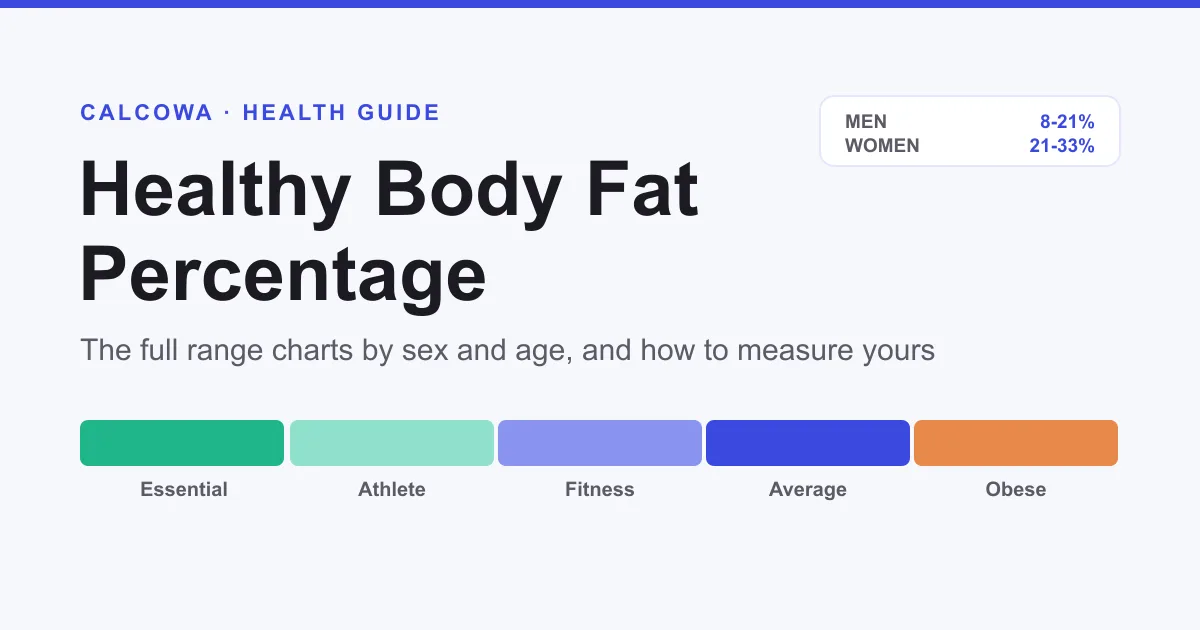
Short answer: a healthy body fat percentage is roughly 21 to 33 percent for women and 8 to 21 percent for men, and the healthy range shifts upward as you age. Women naturally sit higher than men because some fat is essential for hormones and reproduction. Body fat percentage tells you far more about your health than the number on the scale, because it separates fat from the muscle, bone, and water that also make up your weight. This guide gives you the full range charts by sex and age, shows you how to measure yours without a lab, and explains why it beats BMI for most people.
If you’d rather skip the arithmetic, the body fat calculator turns a few tape measurements into an estimate in seconds. Everything below explains what that number means and how to move it.
What is a healthy body fat percentage?
Your body fat percentage is simply the share of your total weight that’s fat, with everything else, muscle, bone, water, and organs, counted as lean mass. A 180-pound man at 20 percent body fat is carrying 36 pounds of fat and 144 pounds of lean tissue. That split is what makes the measure so useful. Two people can weigh exactly the same and look completely different, and body fat is the number that explains the gap.
Not all fat is optional. A baseline called essential fat keeps your organs cushioned and your hormones running, and you can’t safely drop below it. Above that floor, the healthy zone is a range, not a single target. Here’s how the standard categories from the American Council on Exercise break down for each sex.
| Category | Women | Men |
|---|---|---|
| Essential fat | 10-13% | 2-5% |
| Athletes | 14-20% | 6-13% |
| Fitness | 21-24% | 14-17% |
| Average | 25-31% | 18-24% |
| Obese | 32% and up | 25% and up |
Most people who describe themselves as healthy and active land in the fitness or average bands. You don’t need to chase the athlete range to be healthy, and for a lot of people trying to get there means dieting harder than it’s worth. The goal for general health is staying out of the obese category and holding a number you can maintain without misery.
What’s a healthy body fat percentage by age?
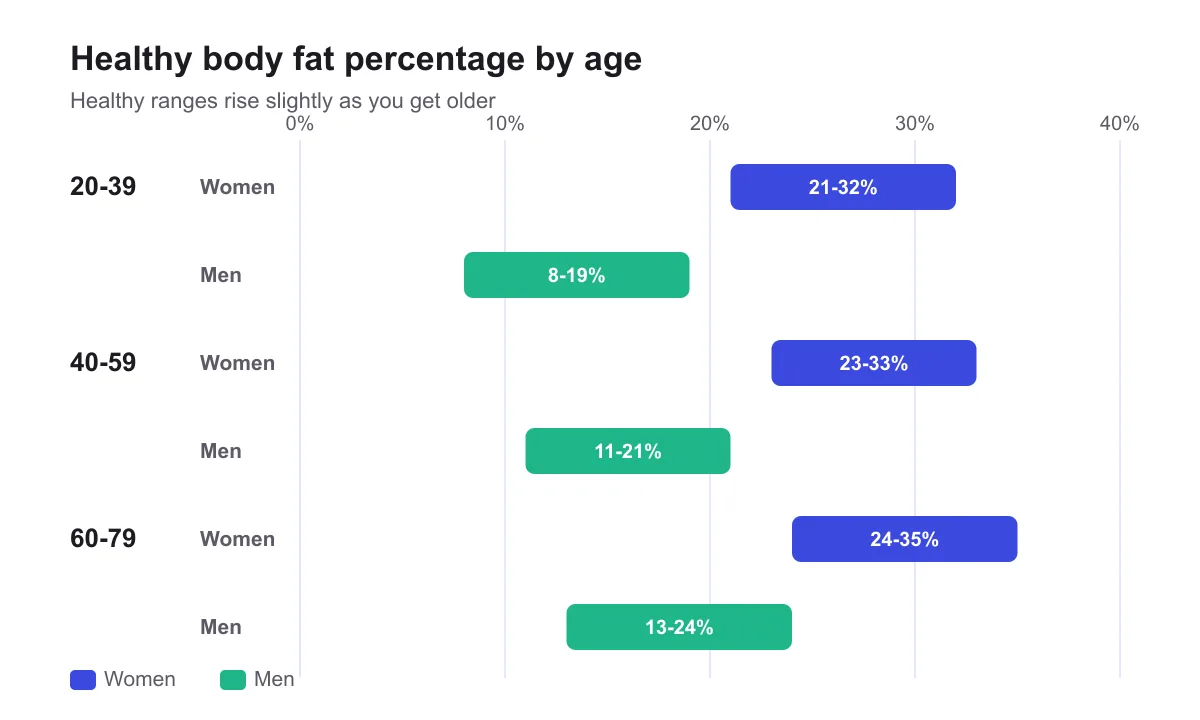
Here’s the part a lot of charts leave out: the healthy range isn’t fixed for life. As you get older, your body composition shifts, you lose a little muscle and store a bit more fat, so a slightly higher body fat percentage stays perfectly healthy. Judging a 60-year-old against a 25-year-old’s chart isn’t fair or accurate. These healthy ranges come from body composition research linking body fat to a normal weight at each age.
| Age | Women (healthy) | Men (healthy) |
|---|---|---|
| 20-39 | 21-32% | 8-19% |
| 40-59 | 23-33% | 11-21% |
| 60-79 | 24-35% | 13-24% |
Read your own row rather than the headline number. A woman at 30 percent in her 50s is healthy, while the same 30 percent in a man of any age is pushing toward the high end. If your number sits above your bracket, it doesn’t mean anything is wrong today, it just means trimming some fat would lower your long-term risk. Pair this with a look at your energy needs using the TDEE calculator so any changes you make are based on real numbers.
Why do women need more body fat than men?
If you’ve compared charts and wondered why women’s healthy numbers run so much higher, it comes down to biology, not fitness. Women carry more essential fat, roughly 10 to 13 percent versus 2 to 5 percent for men. That extra fat supports estrogen production, menstrual cycles, and the ability to carry a pregnancy, so it’s doing a job, not sitting idle.
This is why a woman at 24 percent can look athletic and lean while a man at 24 percent looks softer and sits in the average range. It’s also why women shouldn’t aim for male-style single-digit numbers. Pushing a woman’s body fat too low is one of the fastest ways to stop periods and weaken bones, which we’ll come back to at the end. When you read any body fat guidance, always check that it’s using the chart for your sex.
How is body fat different from BMI?
Body Mass Index only uses your height and weight, so it can’t tell muscle from fat. That’s its blind spot. A muscular person often gets flagged as overweight by BMI while carrying a healthy amount of fat, and a lightly built person can pass BMI while quietly holding too much fat, the so-called skinny-fat pattern. Body fat percentage sees straight through both cases because it measures the fat directly.
| Person | Height / weight | BMI verdict | Body fat | Reality |
|---|---|---|---|---|
| Muscular lifter | 5’10”, 200 lb | Overweight (28.7) | 14% | Lean and healthy |
| Skinny-fat office worker | 5’10”, 160 lb | Normal (23.0) | 27% | Too much fat |
| Average adult | 5’10”, 175 lb | Normal (25.1) | 20% | Genuinely healthy |
None of this means BMI is useless. It’s a fast, free screen that works fine for large groups and for people who aren’t especially muscular. But when the two disagree, body fat wins, because it’s measuring what actually matters. If you want to see the contrast for yourself, run your stats through the BMI calculator and then compare it against your body fat number. Our guide on how to lose weight the healthy way digs into why the scale alone can mislead you.
How can you measure your body fat percentage?
You’ve got a spread of options, from a free tape measure to a lab scan, and they trade accuracy for cost and convenience. Here’s the honest picture, including the error margin each method carries, since no home method is perfectly precise and it helps to know how much wiggle room you’re working with.
| Method | Typical error | Rough cost | Best for |
|---|---|---|---|
| Tape (Navy method) | ±3-4% | Free | Quick tracking at home |
| Skinfold calipers | ±3.5% | $10-30 | Consistent home trend |
| Bioelectrical scale (BIA) | ±4-5% | $30-60 | Convenience, daily check |
| Bod Pod (air displacement) | ±2-3% | $40-75 | Higher accuracy, no water |
| Hydrostatic weighing | ±2-3% | $40-60 | Lab-grade, older gold standard |
| DEXA scan | ±1-2% | $50-150 | The most accurate, plus bone data |
For everyday people, the smartest move usually isn’t the fanciest tool, it’s the most consistent one. A cheap tape or caliper measured the same way each time tracks your direction reliably, even if the absolute number is a couple points off. Save a DEXA scan for a baseline or a check-in every few months. Whatever you pick, measure under the same conditions each time, since hydration, food, and time of day all nudge the reading.
How do you measure body fat with a tape?
The Navy tape method is the free option most people reach for, and it’s what powers a lot of online estimators. You need a soft tape measure and two or three measurements. For men, you measure your waist at the navel and your neck. For women, you add a hip measurement. Then the formula compares those circumferences against your height.
| You measure | Men | Women |
|---|---|---|
| Neck | Yes | Yes |
| Waist (at navel) | Yes | Yes |
| Hip (widest point) | No | Yes |
| Height | Yes | Yes |
The math is fiddly by hand, so here’s a worked example for a man to show it isn’t magic. Say he’s 70 inches tall with a 36-inch waist and a 15-inch neck. The formula takes the difference between waist and neck, weighs it against height on a log scale, and lands at about 21 percent body fat. That’s a believable number for an average, healthy man in his 30s. Rather than punch logarithms into a phone, drop your measurements into the body fat calculator and it handles the formula for both sexes instantly. Measure first thing in the morning, keep the tape snug but not tight, and take each reading twice to average out slips.
What body fat percentage do you need to see abs?
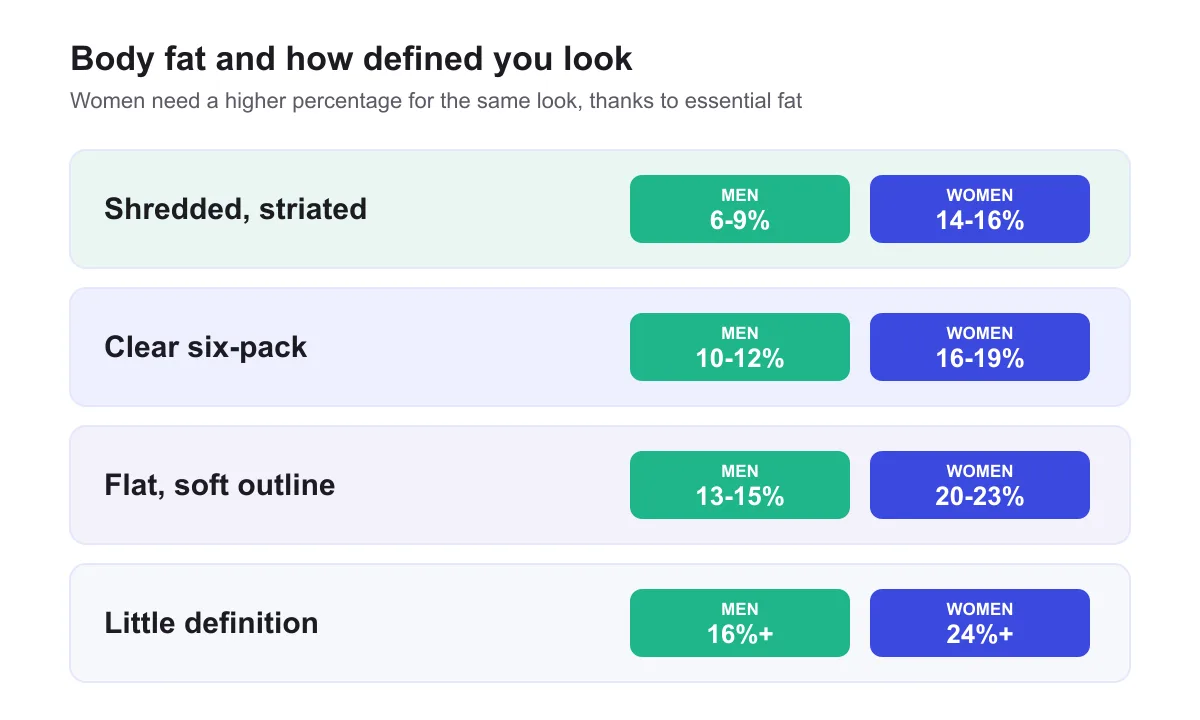
This is the question behind a huge share of body fat searches, so let’s answer it straight. Visible abs are mostly about how thin the fat layer over your stomach is, and that layer thins out at predictable points. Because women carry more essential fat, their visible-abs threshold sits higher than men’s, which surprises people who compare themselves to the wrong photos.
| Look | Men | Women |
|---|---|---|
| Shredded, striated | 6-9% | 14-16% |
| Clear six-pack | 10-12% | 16-19% |
| Flat, soft outline | 13-15% | 20-23% |
| Little visible definition | 16%+ | 24%+ |
Keep in mind that genetics decide where you store fat and how your abs are shaped, so two people at the same body fat can look different. Getting to the striated end of this chart usually means dieting hard enough that it’s tough to sustain, and it isn’t necessary for health. Plenty of genuinely fit people sit at the flat-outline stage and feel great. Decide what you actually want before you commit to the grind of getting there.
How do you lower your body fat percentage safely?
Lowering body fat comes down to one principle with a few smart supports: eat a bit less than you burn so your body taps its fat stores, while eating enough protein and training so the weight you lose is fat, not muscle. A moderate calorie deficit does the heavy lifting, and you can size yours with our guide on how many calories to lose weight.
Here’s a realistic timeline most people can expect. Roughly 3 to 4 pounds of fat loss lowers body fat by about 1 percent for an average adult, and a safe pace trims half a pound to a pound of fat per week.
| Goal | Fat to lose (180 lb person) | Realistic time |
|---|---|---|
| Drop 1% | 3-4 lb | 3-6 weeks |
| Drop 3% (one category tier) | 9-12 lb | 2-4 months |
| Drop 5% | 15-20 lb | 4-6 months |
Three things protect your muscle while you cut. First, keep protein high, around 0.7 to 1 gram per pound of bodyweight, which our guide on how much protein per day breaks down by size and goal. Second, keep lifting, since strength training tells your body to hold onto muscle. Third, don’t crash diet, because huge deficits burn muscle alongside fat and stall your metabolism. Progress is quick early and slows as you lean out, so judge yourself on the monthly trend, not day-to-day swings. If you want your full plan mapped out, our guide on how to lose weight the healthy way ties the eating and training together.
Does where you store fat matter?
Two people can share the same body fat percentage and carry very different health risk, because where the fat sits matters as much as how much you have. There are two kinds. Subcutaneous fat is the soft layer just under your skin, the stuff you can pinch. Visceral fat is the deeper fat packed around your organs inside your abdomen, and it’s the more dangerous of the two. Visceral fat is metabolically active, and higher levels track with a greater risk of heart disease, type 2 diabetes, and high blood pressure, even in people whose overall body fat looks fine.
The catch is that a body fat percentage alone can’t tell you the split. That’s where a simple backup measure helps: your waist-to-height ratio. Measure your waist at the navel and divide by your height in the same units. Keeping that number under 0.5 is a well-supported target, meaning your waist should be less than half your height.
| Waist-to-height ratio | What it suggests |
|---|---|
| Under 0.4 | Lean, low visceral fat |
| 0.4 to 0.49 | Healthy range |
| 0.5 to 0.59 | Raised risk, worth trimming |
| 0.6 and up | High risk, act on it |
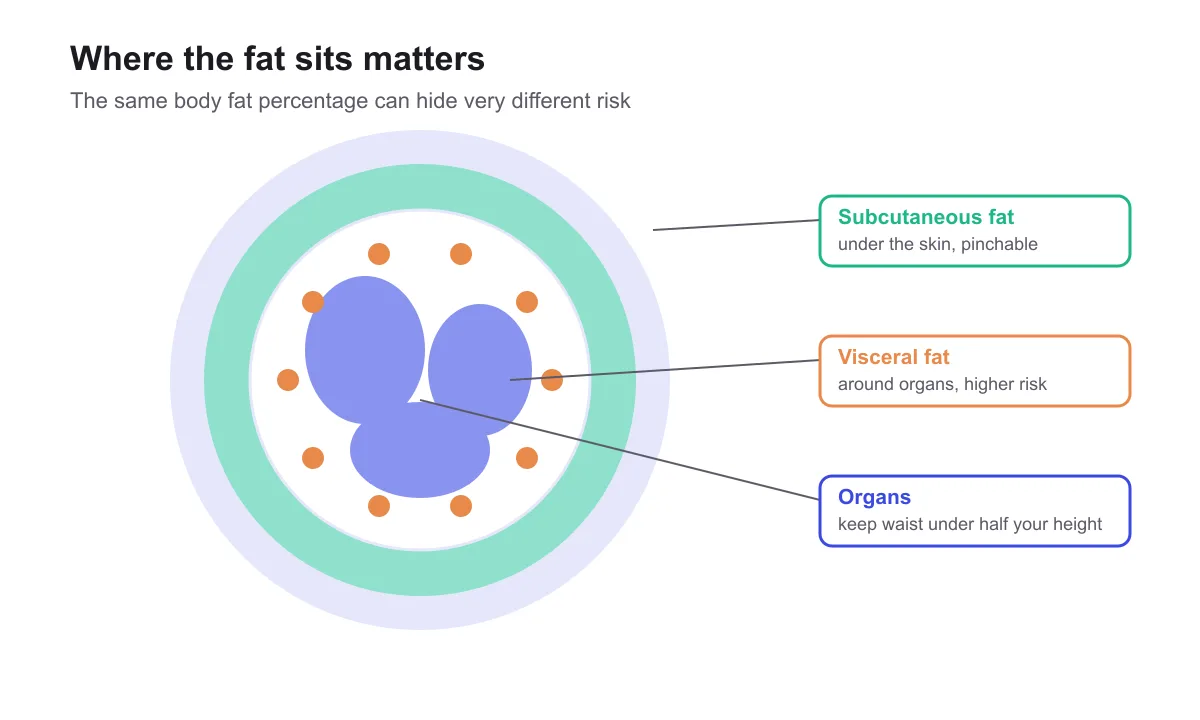
The good news is that visceral fat is often the first fat to go when you start eating in a deficit and moving more, so the same habits that lower your body fat percentage tend to shrink the risky deep fat fastest. If your waist is creeping past half your height, that’s a clearer call to action than any single body fat reading. Track both and you get a fuller picture than either number gives on its own.
Is a very low body fat percentage dangerous?
It’s easy to assume leaner is always better, but body fat isn’t the enemy, and dropping too low carries real costs. Everyone needs essential fat, about 2 to 5 percent for men and 10 to 13 percent for women, just to keep organs, nerves, and hormones running. Getting near that floor, or below it, starts breaking things. In women it commonly stops menstrual periods, a warning sign of low hormones that also weakens bones over time. In both sexes it can bring constant fatigue, a weaker immune system, poor recovery, and a low mood.
That’s why the single-digit numbers you see on stage bodybuilders aren’t a health goal. They peak there for a day and then deliberately come back up. For nearly everyone, the sweet spot is the fitness or athletic range for your sex, lean enough to look and feel great, high enough to keep your body running well. If you’re a woman noticing your periods change as you lean out, treat that as a signal to ease up, not push harder. A healthy body fat percentage is a range you can live in, not a razor’s edge you have to balance on.
Frequently asked questions
For most women, a healthy body fat percentage sits between about 21 and 33 percent, and the healthy band shifts up with age. A woman in her 20s or 30s is usually in good shape between 21 and 32 percent, while the same woman in her 60s can be healthy up to about 35 percent. Women naturally carry more fat than men because some of it is essential for hormones and reproduction, so a number that looks high next to a man's chart is often perfectly normal. Athletes commonly sit lower, around 14 to 20 percent, but going far below that can disrupt periods and bone health.
A healthy body fat percentage for men runs roughly 8 to 21 percent, again drifting higher with age. A man in his 20s or 30s is typically healthy between 8 and 19 percent, and by his 60s the top of the healthy range moves up near 24 percent. The fitness range, where you look lean and defined without extreme dieting, lands around 14 to 17 percent. Below 6 percent is essential fat only and isn't sustainable or safe for most people. If you're carrying more than about 25 percent as a younger man, that's the point where health risks start climbing.
It depends entirely on your sex and age. For a woman, 25 percent is squarely in the healthy, normal range at almost any age. For a man, 25 percent sits right at the edge where the average category tips into the obese category, so it's a signal to pay attention, though it isn't an emergency. Context matters too. A very muscular man measured by a cheap scale might read 25 percent when a lab scan would say 20, so don't panic over a single reading. Use the trend across weeks rather than one number.
Visible abs show up around 10 to 12 percent for men and 16 to 20 percent for women, though genetics move that line a lot. Some people see a faint outline higher than that, and others need to get leaner before the definition pops. The reason women need a higher number is essential fat, which naturally softens ab definition. Chasing very low body fat just for visible abs often means aggressive dieting that's hard to hold, so it's worth deciding whether the look is worth the effort before you commit to it.
Home body fat scales use bioelectrical impedance, and they're convenient but not precise, with an error margin around 4 to 5 percent in either direction. They send a tiny current through your body and estimate fat from the resistance, which is heavily swayed by how hydrated you are. Step on dehydrated in the morning and the reading looks lean, step on after a big drink and it jumps. The trick is to weigh yourself under the same conditions every time, first thing in the morning after using the bathroom, and watch the direction it moves rather than trusting the exact figure.
Yes, and it's a real risk, not just a theoretical one. Everyone needs essential fat, about 2 to 5 percent for men and 10 to 13 percent for women, just to keep organs, nerves, and hormones working. Dropping near or below that line can cause hormone problems, loss of menstrual periods in women, weakened bones, poor immunity, and constant fatigue. Competitive bodybuilders hit very low numbers for a single day on stage and then come back up on purpose. For everyday health, staying in the fitness or athletic range gives you a lean look without the downsides of going too far.
For most people, dropping 1 percent of body fat takes about one to four weeks of steady effort, depending on your starting point and how big a calorie deficit you run. A rough guide is that losing 3 to 4 pounds of fat lowers body fat by roughly 1 percent for an average adult, and a safe deficit trims about half a pound to one pound of fat per week. That means one honest month of good eating and training usually shows up as a 1 to 2 percent drop. Progress is faster at the start and slows as you get leaner, so patience pays off near the end.
Calcowa's editorial team builds and checks every calculator against published formulas, then writes these guides so the numbers make sense. Each tool shows its formula and a worked example. See our methodology.
Related guides
Target Heart Rate Zones for Fat Loss
Target heart rate zone for fat loss runs about 60 to 70 percent of your max heart rate, but higher zones burn more total fat. Get the full chart and math.
Health & FitnessCalories Burned Walking: A Complete Guide
Calories burned walking depends on your weight, pace, and incline. A 155-pound person burns about 86 calories per mile at a moderate pace. See the charts.
Health & FitnessWhat Is a Good BMI? Chart and Limits
What is a good BMI? For most adults a healthy BMI runs 18.5 to 24.9, but the number has real blind spots. See the full chart by age, sex, and body type.