
How Many Calories to Lose Weight? Daily Targets
How many calories to lose weight? Find your daily target by goal pace, see why the 3,500 calorie rule overpredicts, and know the safe floor before you cut.
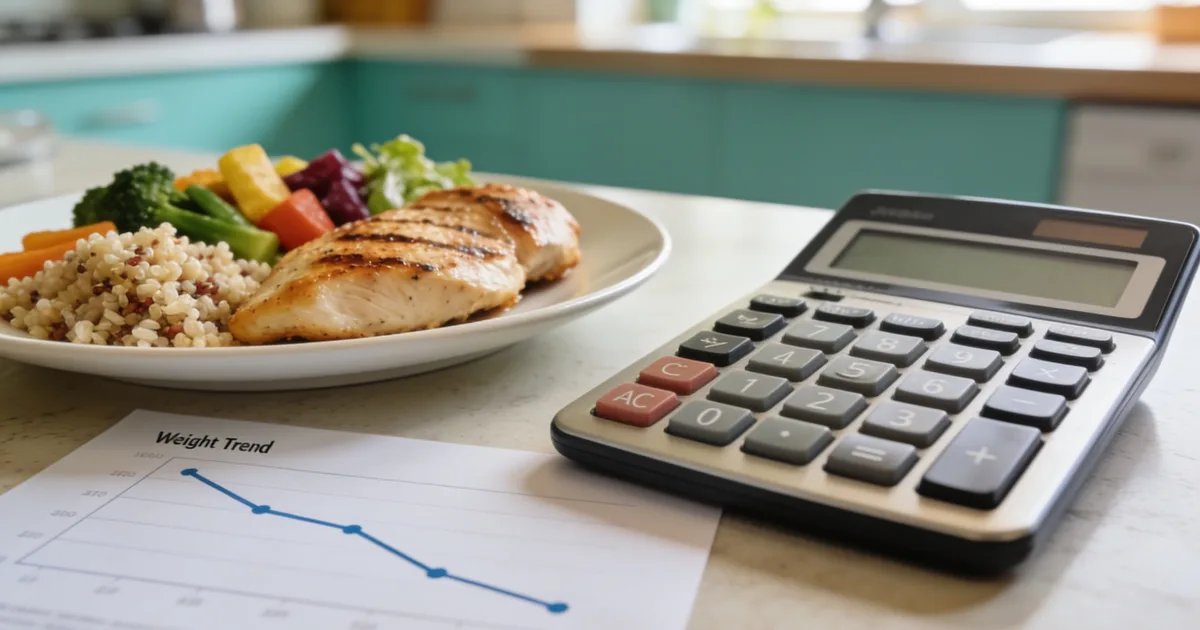
Short answer: most people lose weight steadily on 300 to 500 calories below their maintenance level, which works out to roughly 1,400 to 1,800 calories a day for most women and 1,700 to 2,300 for most men. Asking how many calories to lose weight is really asking two smaller questions: what does my body burn each day, and how big a gap should I leave under that number? This guide answers both, with a target table you can read your answer straight from, the honest math on the 3,500-calorie rule, and the floor you shouldn’t cut below.
If you’d rather skip the arithmetic entirely, the calorie deficit planner turns your stats and goal pace into a daily calorie target in a few seconds.
How many calories to lose weight?
There’s no single number, and that’s the part most articles bury. Weight loss happens whenever you eat fewer calories than your body burns, so the right intake depends entirely on your burn. A 6’1” active man burning 2,900 calories loses weight on 2,400. A 5’3” woman with a desk job burning 1,750 gains on that same 2,400.
The working recipe has three steps:
- Find your maintenance calories (what you burn per day, also called TDEE).
- Subtract a deficit, usually 300 to 500 calories, up to 1,000 if your burn is high.
- Hold it for two to three weeks and let the scale confirm the math, then adjust.
That gap between eating and burning is the engine behind every diet that works. If you want the mechanism explained in full, we’ve covered what a calorie deficit is separately. This article stays on the practical question: your actual daily number.
How do you find your maintenance calories first?
Your body spends energy on three things: staying alive (your basal metabolic rate), digesting food, and movement of every kind. Add them up and you get your total daily energy expenditure, or TDEE. That’s maintenance, the intake at which your weight holds still. The two numbers get mixed up constantly, so here’s the BMR vs TDEE difference if you want the distinction nailed down.
You can estimate maintenance two ways. The quick way is a TDEE calculator, which runs the Mifflin-St Jeor equation and an activity multiplier for you. The reference way is the Dietary Guidelines for Americans, which publishes typical needs by age, sex, and activity:
| Group | Sedentary | Moderately active | Active |
|---|---|---|---|
| Women 19-30 | 1,800-2,000 | 2,000-2,200 | 2,400 |
| Women 31-59 | 1,800 | 2,000 | 2,200 |
| Women 60+ | 1,600 | 1,800 | 2,000-2,200 |
| Men 19-30 | 2,400 | 2,600-2,800 | 3,000 |
| Men 31-59 | 2,200-2,400 | 2,400-2,600 | 2,800-3,000 |
| Men 60+ | 2,000-2,200 | 2,200-2,400 | 2,400-2,600 |
Treat these as population averages, not your personal truth. Height and weight swing individual numbers by several hundred calories in either direction, which is exactly why copying a friend’s diet so often fails one of you.
What should your daily calorie target be?
Here’s the table the rest of this article exists for. Find the row closest to your maintenance burn, pick your goal pace, and read your daily calorie target. Cells marked too low fall under 1,200 calories, the floor below which nobody should cut without medical supervision. Values with an asterisk sit under 1,500, which is fine for many women but below the floor most dietitians use for men.

| Your maintenance (TDEE) | Lose 0.5 lb/week | Lose 1 lb/week | Lose 1.5 lb/week | Lose 2 lb/week |
|---|---|---|---|---|
| 1,600 | 1,350* | too low | too low | too low |
| 1,800 | 1,550 | 1,300* | too low | too low |
| 2,000 | 1,750 | 1,500 | 1,250* | too low |
| 2,200 | 1,950 | 1,700 | 1,450* | 1,200* |
| 2,400 | 2,150 | 1,900 | 1,650 | 1,400* |
| 2,600 | 2,350 | 2,100 | 1,850 | 1,600 |
| 2,800 | 2,550 | 2,300 | 2,050 | 1,800 |
| 3,000 | 2,750 | 2,500 | 2,250 | 2,000 |
Two patterns worth noticing. First, the smaller your burn, the fewer paces you can safely pick: someone maintaining on 1,600 really only has the half-pound lane, while someone at 2,800 can choose almost any speed. Second, “eat 1,500 calories” is a 1-pound-per-week plan for one person and a maintenance diet for another. Generic targets fail because they ignore the left column.
The CDC’s guidance points at the same middle lanes: gradual loss of 1 to 2 pounds per week is the pace people actually sustain and keep off. If your row says your preferred pace is too low, the answer isn’t to push through it. It’s to pick the slower column, or to raise your burn with more daily movement so you shift down a row. You can also just enter your stats and goal pace and get this same answer computed for your exact height, weight, and age instead of the nearest row.
How many calories are in a pound of fat?
About 3,500, and that single number powers the whole table above. A pound of body fat isn’t pure fat; it carries some water and protein, so the true energy content ranges from roughly 3,400 to 3,750 calories. The 3,500 figure comes from Max Wishnofsky’s 1958 paper and has survived as the planning standard because it’s close enough and easy to divide.
Divide it across a week and you get the familiar pairings: a 500-calorie daily deficit adds up to 3,500 a week, or about a pound. To make the size of that number concrete:
| One pound of fat (~3,500 calories) equals | Roughly |
|---|---|
| Daily eating gap for a week | 500 calories/day for 7 days |
| Gentler eating gap | 250 calories/day for 14 days |
| Walking, and nothing else | ~35 miles of brisk walking |
| Running, and nothing else | ~4.5 hours at a 10-minute-mile pace |
| Skipped soda | ~14 cans of regular cola |
The walking and running rows explain why “just exercise more” rarely works alone. Out-walking your fork means marathon-level mileage per pound, while skipping two snacks a day gets there quietly. Exercise still earns its place, just further down this page.
Why do you lose less than the 3,500 rule predicts?
Here’s what almost no calorie article shows you with numbers. The 3,500 rule is linear: it assumes the deficit you set in week one stays the same size forever. Your body disagrees. As you lose weight, a lighter body burns fewer calories doing everything, and your metabolism adapts a few percent downward on top of that. The deficit quietly shrinks even though your eating hasn’t changed.
Here’s how that plays out for someone who starts at a true 500-calorie daily deficit and never changes their intake:
| Timeline | 3,500-rule prediction | Realistic range | What’s happening |
|---|---|---|---|
| Month 1 | ~4.3 lb | 3.5-4.5 lb | Water shifts blur the picture both ways |
| Month 3 | ~13 lb | 9-12 lb | A lighter body now burns less all day |
| Month 6 | ~26 lb | 15-20 lb | Adaptation compounds; the gap has shrunk |
These realistic figures line up with validated dynamic models like the NIH Body Weight Planner, which project roughly half the linear rule’s estimate by the one-year mark. The lesson isn’t that the rule is useless. It’s excellent for the first month or two. The lesson is to recalculate your maintenance every 10 pounds lost and re-subtract your deficit from the new, smaller number. Dieters who never update their target usually stall around month three or four and blame themselves, when the real issue is that they’re eating at their new maintenance without knowing it.
Should you eat less or burn more to hit your number?
Both levers move the same equation, but they don’t cost the same effort. Cutting 500 calories with food alone means real restriction every single day. Burning 500 through exercise alone means 75 to 90 minutes of brisk walking daily, and exercise nudges appetite up for many people, which claws part of it back. The combination is where most people find a sustainable rhythm:

| Way to build a 500-calorie day | What it looks like | The catch |
|---|---|---|
| Food only (cut 500) | Swap the latte, drop the soda, shrink dinner by a third | Feels restrictive; harder at social meals |
| Exercise only (burn 500) | 75-90 min brisk walking or ~50 min running, daily | Big time cost; appetite often rises |
| Split: 300 food + 200 movement | Two food swaps plus a 40-minute walk | Honestly, not much; this is the easy mode |
| Weekday food focus | Cut 700 on weekdays, relax to maintenance on weekends | Weekend overshoot can erase the week |
A note on the burn side: searches for how many calories you should burn a day to lose weight usually have the model backwards. You don’t need a burn quota. You need your total intake below your total burn, however the two get there. A daily step target plus two or three strength sessions a week protects muscle and adds a couple hundred calories of expenditure without turning training into a math assignment.
On the food side, protein is the one macro worth planning first, around 0.7 to 1 gram per pound of goal body weight. It’s the most filling macronutrient and it protects muscle while the fat comes off, which keeps your burn from dropping faster than it has to.
Is your calorie target too low?
The internet loves round numbers, so most people end up on 1,200, 1,500, or 1,800 without checking whether those fit their body. Here’s the honest matchmaking:
| Popular target | Works for | Wrong for |
|---|---|---|
| 1,200 | Smaller, sedentary women, ideally with medical guidance | Most men, anyone active, anyone hungry all day on it |
| 1,500 | Many women with average burns; smaller men at a half-pound pace | Active people; anyone whose maintenance is near 1,700 |
| 1,800 | Most men cutting at 1 lb/week; active women | Small sedentary women (it’s their maintenance, not a deficit) |
| 2,000 | Active men; very active women | Anyone whose TDEE sits near 2,000, since nothing happens |
Warning signs your target is under your body’s tolerance: hunger that dominates the day, workouts losing weight and reps, constant cold or fatigue, irritability, poor sleep, hair shedding, or missed periods. Those aren’t discipline tests to pass. Move up a column, eat at maintenance for a week or two, and restart with a smaller gap. Slower and sustained beats fast and abandoned every time it’s been studied.
Anyone pregnant, on medications that affect weight, managing a health condition, or with any history of disordered eating should set targets with a doctor rather than a table.
How do you know your target is working?
Formulas estimate; scales verify. Every equation in this article can miss your true maintenance by 200 calories either way, so the last step is a live test. Eat your target consistently for two to three weeks. Weigh in each morning after the bathroom, average each week, and compare weekly averages, because day-to-day readings bounce with salt, carbs, and water too much to mean anything alone.
Then read the result like a scientist:
- Weekly average falling at roughly your goal pace? Your number is right. Change nothing.
- Falling much faster than planned? You’re under-eating for the pace you picked. Add 150 to 200 calories, especially if the warning signs above are creeping in.
- Flat for three or more weeks? Your real maintenance is lower than the estimate, or tracking has drifted. Trim 150 to 200 calories or tighten logging for two honest weeks before cutting further.
And every 10 pounds lost, run the numbers again, because the person doing the losing keeps changing. Your maintenance drops as you shrink, so the target that started as a 500-calorie deficit won’t stay one. Two minutes with the calorie deficit calculator at each 10-pound checkpoint keeps the gap real all the way to goal, and that single habit prevents the month-three stall that ends most diets.
Frequently asked questions
Take your maintenance calories and subtract 300 to 500. For most women that lands between 1,400 and 1,800 calories a day, and for most men between 1,700 and 2,300. Those are wide ranges because maintenance depends on your size, age, and activity. Someone with a 2,600-calorie burn can cut on 2,100, while someone burning 1,800 needs to sit near 1,400. Your number comes from your burn, not from a diet plan's default.
It's below maintenance for almost every adult, so yes, it produces loss. That doesn't make it a good pick. At 1,200 calories it gets genuinely hard to cover protein, iron, calcium, and fiber needs, and hunger tends to win eventually. Dietitians treat 1,200 as the floor for women, not a target, and men shouldn't go under about 1,500. If your math says you need less than that to lose, slow the goal pace instead.
Most adults burn between 1,600 and 3,000 calories a day, counting everything: keeping organs running, digesting food, workouts, and ordinary moving around. Sedentary women often sit near 1,600 to 2,000, sedentary men near 2,200 to 2,400, and active people run several hundred higher. A TDEE calculator gives you a solid estimate from your age, sex, height, weight, and activity level in a few seconds.
About 1,000 calories a day below maintenance, since each pound of fat stores roughly 3,500 calories. That's an aggressive gap. It only works comfortably for people with a high burn, say 2,800 calories or more, because everyone else would land below the 1,200 to 1,500 intake floor. If the subtraction pushes you under the floor, aim for 1 to 1.5 pounds a week instead and let the extra weeks do the work.
Roughly 3,500, which is where the classic rule comes from. The honest range is about 3,400 to 3,750 calories, because body fat tissue isn't pure fat; it holds some water and protein too. The figure traces back to researcher Max Wishnofsky in 1958. It works fine for short-term planning, but over months it overpredicts loss because your body's burn drops as you shrink.
No. The deficit has to exist, but you don't have to log it. Fixed meal templates, bigger protein and vegetable portions, cutting liquid calories, and keeping treats out of the house all create a gap without an app. Counting is just the fastest way to find your numbers and to debug a stall. Plenty of people count for a month to learn portions, then drop the app and hold their results.
After three or more flat weeks, the boring answer is usually that the deficit isn't real: untracked oils, bites, and weekend meals close a 500-calorie gap fast. Water retention from new exercise or high salt can also hide fat loss for a couple of weeks. Recheck your maintenance number at your current weight, tighten tracking for two weeks, and the trend almost always shows up.
Calcowa's editorial team builds and checks every calculator against published formulas, then writes these guides so the numbers make sense. Each tool shows its formula and a worked example. See our methodology.
Related guides
Target Heart Rate Zones for Fat Loss
Target heart rate zone for fat loss runs about 60 to 70 percent of your max heart rate, but higher zones burn more total fat. Get the full chart and math.
Health & FitnessCalories Burned Walking: A Complete Guide
Calories burned walking depends on your weight, pace, and incline. A 155-pound person burns about 86 calories per mile at a moderate pace. See the charts.
Health & FitnessWhat Is a Healthy Body Fat Percentage?
A healthy body fat percentage depends on your sex and age. See the full range charts, how to measure yours accurately, and why it beats BMI as a marker.