
How to Pay Off Credit Card Debt Fast
How do you pay off credit card debt fast? Compare the snowball and avalanche methods with a real worked example, and see which clears your cards sooner.
Short answer: pay more than the minimum, and throw every extra dollar at one card at a time. The two proven systems for doing that are the debt snowball (smallest balance first) and the debt avalanche (highest interest rate first). Both work far better than spreading spare cash thinly across every card. Here’s how each one works, a real example with the actual numbers, and how to pick.
Want your exact debt-free date? The debt snowball calculator runs both methods on your real balances and shows you month by month when each card hits zero.
This is general information to help you plan, not personalized financial advice.
The two proven ways to pay off credit card debt
If you’ve got more than one card, the question isn’t just “pay more,” it’s “which card gets the extra money first?” That order is what separates a plan from a hope. There are two systems worth knowing, and they only differ in that one choice.
- Debt snowball: pay minimums on everything, then put every spare dollar on your smallest balance first. When it’s gone, roll that payment onto the next smallest.
- Debt avalanche: same idea, but you attack your highest interest rate first, regardless of balance.
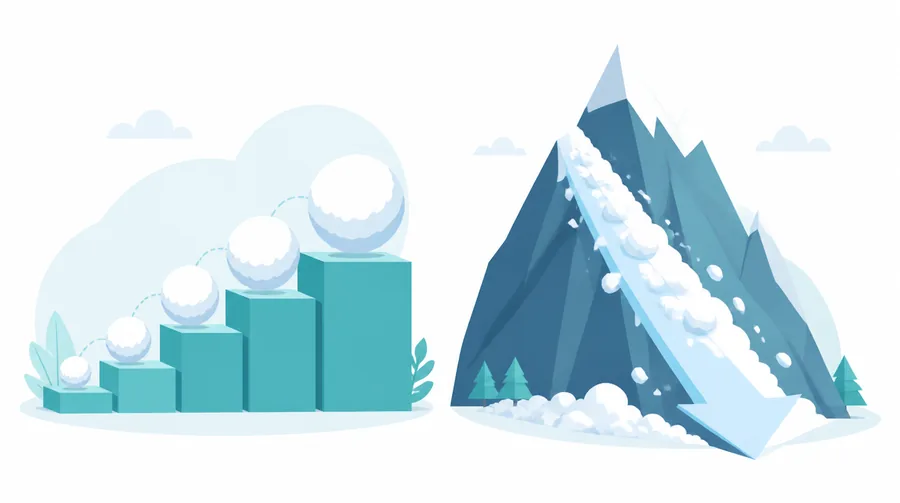
Everything else is identical. You still pay minimums on all cards, you still add every extra dollar to one target, and you still “roll” the freed-up payment forward when a card is cleared. That rolling effect is why it’s called a snowball: your monthly attack payment keeps growing.
The debt snowball method
The snowball is about momentum. You line your debts up from smallest balance to largest, ignore the interest rates for now, and pour everything extra into the smallest one. Because small balances clear quickly, you get a card paid off fast, sometimes within a couple of months, and that early win is powerful.
That psychology isn’t a gimmick. Personal finance educator Dave Ramsey popularized the snowball precisely because people who see quick progress are far more likely to keep going. Getting out of debt is a long game, and the method you’ll actually finish beats the one that looks best on paper but burns you out.
The debt avalanche method
The avalanche is about math. You order your debts by interest rate, highest first, and attack the most expensive one while paying minimums on the rest. Since interest is what makes debt grow, killing your highest-rate balance first means less of your money gets eaten along the way.
The avalanche always costs you the least in total interest. The catch is that your highest-rate card isn’t always your smallest, so your first “win” can take longer to arrive. If you’re the type who’s motivated by saving money rather than checking off cards, the avalanche is your method.
Snowball vs avalanche: a real example
Here’s where most guides stop explaining and where the numbers actually matter. Let’s take a realistic situation: three cards, $18,000 in total debt, and a budget of $650 a month toward all of them.
| Card | Balance | APR | Minimum |
|---|---|---|---|
| Card A | $3,000 | 18% | $60 |
| Card B | $6,000 | 26% | $130 |
| Card C | $9,000 | 21% | $190 |
Notice the twist: Card A has the smallest balance, but Card B has the highest rate. So the two methods start in different places. The snowball hits Card A first; the avalanche hits Card B first. Here’s how the whole plan plays out.
| Method | Order | Debt-free in | Total interest | First card cleared |
|---|---|---|---|---|
| Snowball | A, B, C | 40 months | $7,528 | Month 10 |
| Avalanche | B, C, A | 39 months | $6,923 | Month 19 |
Read those two rows carefully, because they tell the whole story. The avalanche saves you $605 in interest and finishes a month sooner. But the snowball hands you your first paid-off card at month 10, nine months before the avalanche clears anything.
So the real trade is this: the snowball costs about $605 extra for the reward of a motivating win almost a year earlier. For some people that $605 is worth every penny because it’s what keeps them in the game. For others, saving the money is the win. Neither answer is wrong. Run your own numbers in the debt snowball calculator to see your version of this table.
So which method should you choose?
Use this simple filter:
- Choose the avalanche if your cards have very different rates (say one is 26% and another is 15%). The interest savings get bigger the wider that gap is, so the math clearly wins.
- Choose the snowball if your rates are close together, or if you’ve tried to pay off debt before and lost steam. When the dollar difference is small, motivation is the tie-breaker, and the snowball delivers it.
There’s no method that’s right for everyone, only the one you’ll follow to the end. Be honest with yourself about which kind of progress keeps you going.
The hybrid that gets you both
You don’t have to pick just one. A popular middle path is to start with one quick snowball win, then switch to the avalanche. You knock out your smallest balance first for the psychological boost, then reorder the rest by interest rate to minimize what you pay from there.
In our example, that would mean clearing Card A first (the fast win), then attacking Card B (the 26% card) to save on interest for the long haul. You get the early momentum and most of the math benefit. It’s a smart compromise if you genuinely can’t decide.
First, understand the minimum payment trap
Before you pick a method, here’s why doing nothing extra is so costly. Minimum payments are designed to keep you in debt, not get you out. They’re usually around 1 to 2 percent of your balance plus interest, so as your balance drops, so does the payment, which stretches the timeline for years.
Take a single $6,000 card at 24% APR. If you pay only the minimum, it takes about 219 months, or 18.2 years, and you’ll pay roughly $10,442 in interest, nearly tripling what you borrowed. Add just $200 a month on top and that same debt is gone in under three years. The lesson is blunt: the minimum is the trap, and any extra payment is your escape.
7 ways to pay off credit card debt faster
The method decides the order. These tactics free up more money to feed it.

- Always pay more than the minimum. Even $50 extra changes the timeline dramatically.
- Use a 0% balance transfer card. Moving debt to a card with no interest for 12 to 21 months means your whole payment attacks the principal. Mind the 3 to 5 percent transfer fee.
- Ask for a lower APR. A quick call to your issuer asking for a rate reduction works more often than people expect, especially with a solid payment history.
- Throw windfalls at it. Tax refunds, bonuses, and gifts are the fastest way to shrink a balance without touching your budget.
- Sell what you don’t use and add the cash to your target card.
- Pause new charges. You can’t fill a bucket that’s leaking. Switch to debit or cash while you dig out.
- Automate the extra payment so it happens before you can spend it.
How to stay out of debt once you’re free
Paying it off is half the job. Staying free is the other half. Keep a small emergency fund, often around $1,000 to start, so the next surprise bill doesn’t send you back to the cards. Keep your paid-off cards open to protect your credit utilization, but treat them like tools, not income.
Then redirect that big monthly payment you were making toward debt into savings or investing. That’s the real prize: the snowball you built to escape debt becomes the one that builds your wealth. See what that same payment could grow into with the compound interest calculator.
Frequently asked questions
Pay more than the minimum every month and put every extra dollar toward one card at a time. The debt avalanche method (highest interest rate first) clears your debt for the least total interest, while the debt snowball method (smallest balance first) gets you a paid-off card sooner for motivation. Both beat spreading extra money across every card.
The avalanche saves you the most money because it kills your highest-rate debt first. The snowball saves less but gives you a quick win, which helps people stick with the plan. If the interest gap between your cards is small, choose the snowball for motivation. If one card has a much higher rate, the avalanche is worth it.
It depends on your balance, rate, and monthly payment. Paying only the minimum on a $6,000 card at 24% APR takes about 18 years and over $10,000 in interest. Paying a few hundred dollars extra each month can cut that to two or three years. The debt snowball calculator shows your exact debt-free date.
Keep a small starter emergency fund, often about $1,000, so a surprise bill doesn't push you back onto the cards. After that, high-interest credit card debt usually costs more than a savings account earns, so paying it down aggressively is the better return on your money.
It can. A 0% balance transfer card moves your debt to a card with no interest for a set period, often 12 to 21 months, so every payment goes to principal. Watch for the transfer fee (usually 3 to 5 percent) and pay it off before the promotional rate ends, or the regular APR kicks back in.
Yes. Lowering your balances reduces your credit utilization, which is one of the biggest factors in your score. Keeping the cards open after you pay them off (rather than closing them) keeps your available credit high and helps your utilization even more.
Calcowa's editorial team builds and checks every calculator against published formulas, then writes these guides so the numbers make sense. Each tool shows its formula and a worked example. See our methodology.
Related guides
How Much House Can I Afford? The Real Math
How much house can I afford? Read your answer from a salary table, compare the 28/36 rule with three others, and see the real monthly cost before you buy.
FinanceHow to Pay Off Your Auto Loan Faster
How to pay off your auto loan faster: five strategies tested on one $28,000 loan, with tables showing how many months and how much interest each one saves.
FinanceHow to Get Out of Debt: A Realistic Plan
How to get out of debt with a plan that actually sticks: six steps, a real four-debt example, and snowball vs avalanche vs hybrid numbers side by side.