
How to Get Out of Debt: A Realistic Plan
How to get out of debt with a plan that actually sticks: six steps, a real four-debt example, and snowball vs avalanche vs hybrid numbers side by side.
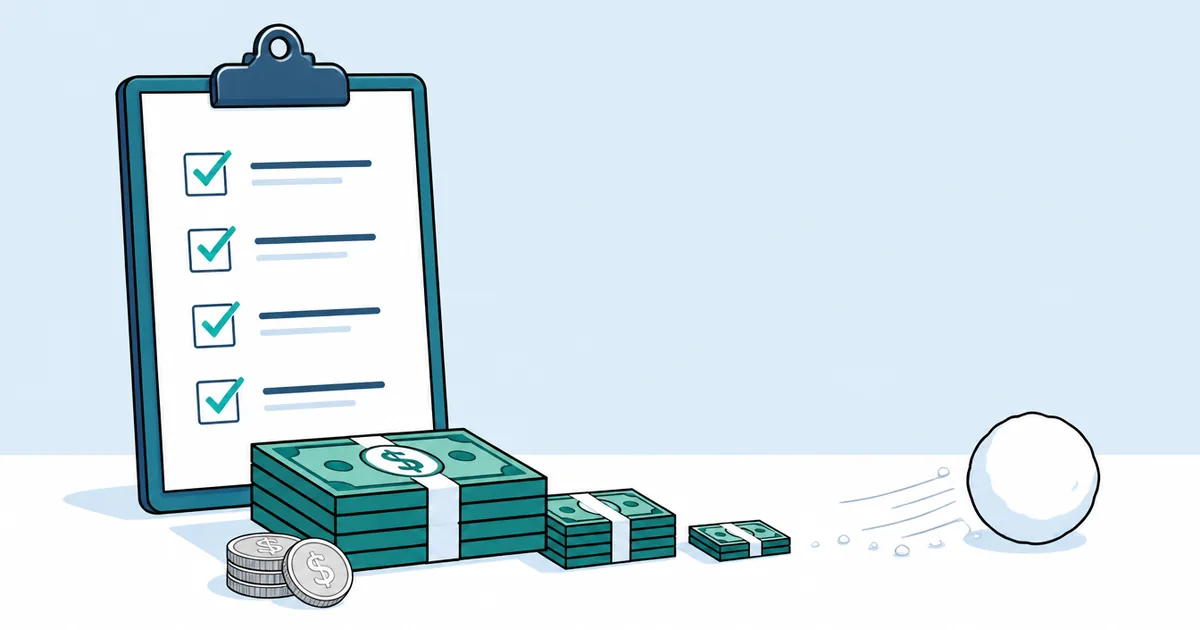
Short answer: you get out of debt by writing down every balance, fixing one monthly payment amount, and attacking one debt at a time while paying minimums on the rest. That’s the whole engine. The reason most people stay stuck isn’t a missing trick, it’s a missing order of operations. This guide covers how to get out of debt in six steps, with a real four-debt example where the snowball, avalanche, and hybrid methods each play out to the exact month and dollar.
Want your own numbers instead of an example? The debt snowball calculator runs your real balances through both methods and shows the month each debt hits zero.
This is general information to help you plan, not personalized financial advice.
Why do most debt payoff plans fail?
Three reasons come up over and over. First, vagueness: “pay extra when I can” isn’t a plan, and money that isn’t assigned a job gets spent. Second, spreading: splitting an extra $300 across five debts feels fair but keeps every balance alive for years, so you never feel progress. Third, no buffer: without a small cash cushion, the first car repair goes straight back on the card and wipes out two months of work.
The fix for all three is the same: a written list, a fixed monthly attack amount, and one target debt at a time. In the worked example below, that structure alone is worth 22 months and about $4,435 in interest compared with drifting along on minimum payments.
How to get out of debt in six steps
Here’s the full plan at a glance. The rest of this guide walks through each step with real numbers.
- List every debt with its balance, APR, and minimum payment.
- Set your monthly debt budget: all the minimums plus a fixed extra attack amount.
- Keep a starter emergency fund of about $1,000 so surprises don’t refill the cards.
- Pick your payoff order: snowball, avalanche, or the hybrid.
- Roll every freed-up payment forward. When a debt clears, its payment joins the attack on the next one.
- Lock in the habits that keep you debt-free once the balances hit zero.
Step 1: How much debt do you actually have?
Most people can’t answer this within $1,000, and that fuzziness is where anxiety lives. So open every statement and build one table: the balance (what you owe today), the APR (the yearly interest rate), and the minimum payment. The balance you’re actually fighting is the principal; interest is the rent you pay on it every month it survives.
Here’s the household we’ll follow through this whole guide. Four debts, $26,200 in total:
| Debt | Balance | APR | Minimum |
|---|---|---|---|
| Medical bill | $1,200 | 0% | $50 |
| Personal loan | $5,000 | 11% | $150 |
| Credit card | $8,000 | 24% | $200 |
| Auto loan | $12,000 | 7% | $280 |
| Total | $26,200 | $680 |
Notice the spread. The medical bill charges nothing. The credit card charges 24%, which means that $8,000 balance grows by about $160 in interest every single month it sits there. Those differences are exactly what your payoff order will exploit.
Step 2: How much can you throw at debt each month?
Your minimums are the floor: $680 here, and they’re not optional. The attack amount is everything above the floor, and it’s the number that decides how fast you’re free. This household combed the budget and found $320, bringing the total to $1,000 a month.
Where did the $320 come from? Nothing dramatic:
| Change | Monthly savings |
|---|---|
| Cut two streaming services and one unused subscription | $45 |
| Meal plan two extra grocery-only weeks | $120 |
| Pause one restaurant night per week | $95 |
| Shop the car insurance renewal | $60 |
| Extra attack amount | $320 |
Yours might be $100 or $600; the system works the same. Two rules make the number stick. Treat the attack amount like a bill, paid on the same date every month, not “whatever’s left.” And keep roughly $1,000 in cash as a starter emergency fund before you start attacking, because a flat tire shouldn’t undo month three.
Step 3: Which debt should you pay off first?
Every payoff method agrees on the mechanics: pay minimums on everything, then send the whole attack amount to one target. When that debt dies, its minimum plus the attack amount roll onto the next target, so your payment snowballs bigger with every win. The only real decision is the order, and you’ve got three good options.
- Debt snowball: smallest balance first. Fastest first win, best for motivation. Dave Ramsey popularized it because people who see a card hit zero early tend to actually finish.
- Debt avalanche: highest APR first. Mathematically cheapest, since your most expensive debt dies soonest.
- Hybrid: grab one quick snowball win first, then switch to avalanche order. You’ll see below how much of the avalanche’s savings it keeps.
Before choosing, know that debt type matters as much as the numbers. Most guides skip this, so here’s the order of operations across the kinds of debt most households carry:
| Debt type | Typical APR | Where it belongs in your order |
|---|---|---|
| Payday / title loans | 300%+ | Always first, before any method starts |
| Credit cards | 18 to 29% | The main target of your snowball or avalanche |
| Personal loans | 8 to 18% | Mid-order target |
| Medical bills | Often 0% | Ask for an interest-free plan; snowball fodder if small |
| Auto loans | 5 to 10% | Usually stays on schedule; it’s secured by the car |
| Federal student loans | 4 to 8% | Keep minimums; protections make early payoff optional |
| Mortgage | 5 to 7% | Last, if ever; attack only when everything above is gone |
A 0% medical bill is mathematically last, but if it’s small, it can be your first snowball win. A payday loan outranks everything because its APR is measured in hundreds. That’s the judgment layer the raw methods don’t capture.
The worked example: four debts, three strategies
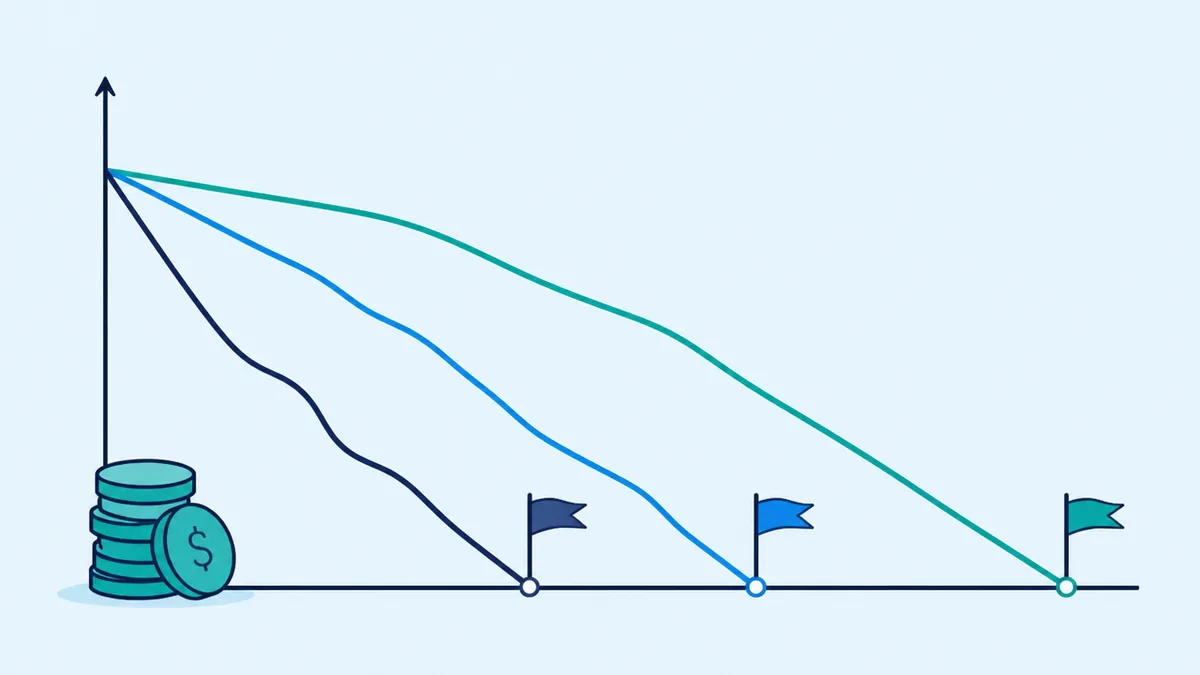
Now let’s run the actual numbers. Same household, same $26,200, same $1,000 a month. The only thing that changes is the order, and we simulated every month of each plan, interest compounding and payments rolling, until the last dollar cleared.
| Method | Payoff order | Debt-free in | Total interest | First win |
|---|---|---|---|---|
| Snowball | Medical, Personal, Card, Auto | 31 months | $4,789 | Month 4 |
| Avalanche | Card, Personal, Medical, Auto | 31 months | $3,867 | Month 19 |
| Hybrid | Medical, Card, Personal, Auto | 31 months | $4,254 | Month 4 |
| Minimums only | (none) | 53 months | $9,224 | Month 24 |
Four things jump out of that table.
Any method crushes no method. Every strategy finishes in 31 months. Minimums alone take 53 months and more than double the interest. The $320 attack amount, applied in any order, saves this household about $4,435 minimum and nearly two years.
The snowball’s motivation has a price tag: $922. That’s the interest gap between snowball ($4,789) and avalanche ($3,867). The snowball spends months feeding the cheap medical bill and personal loan while the 24% card keeps compounding. In exchange, you get a paid-off debt in month 4 instead of month 19. Whether 15 months of earlier momentum is worth $922 is a personality question, not a math one. Plenty of people would rather pay $922 and finish than save $922 and quit at month 8.
The hybrid keeps most of both. Clear the $1,200 medical bill first (month 4, same quick win as the snowball), then jump straight to the 24% card in avalanche order. Total interest: $4,254. That recovers $535 of the snowball’s $922 penalty while keeping the early win. If you can’t choose between the two classic methods, this is your answer.
The finish date barely moves; the interest does. With a fixed monthly budget, the total debt is the same pile either way, so the debt-free date lands within a month across methods. The order mostly decides how much of your $1,000 goes to interest versus principal along the way.
Your own mix of balances and rates will shift these gaps, which is why it’s worth two minutes to run your real numbers through the snowball and avalanche comparison before you commit to an order.
What’s the minimum payment trap?
Minimum payments are designed to keep you in debt, not to get you out. Card issuers typically set the minimum near interest plus 1% of the balance, which means almost nothing touches principal in the early years.
Take this example’s $8,000 card at 24% APR on its own:
| Payment approach | Time to zero | Total interest |
|---|---|---|
| Percent-style minimum (interest + 1%) | About 23 years | About $14,900 |
| Fixed $200 a month | 6 years 10 months | $8,255 |
| Fixed $400 a month | 2 years 2 months | $2,319 |
| Fixed $520 a month | 1 year 7 months | $1,657 |
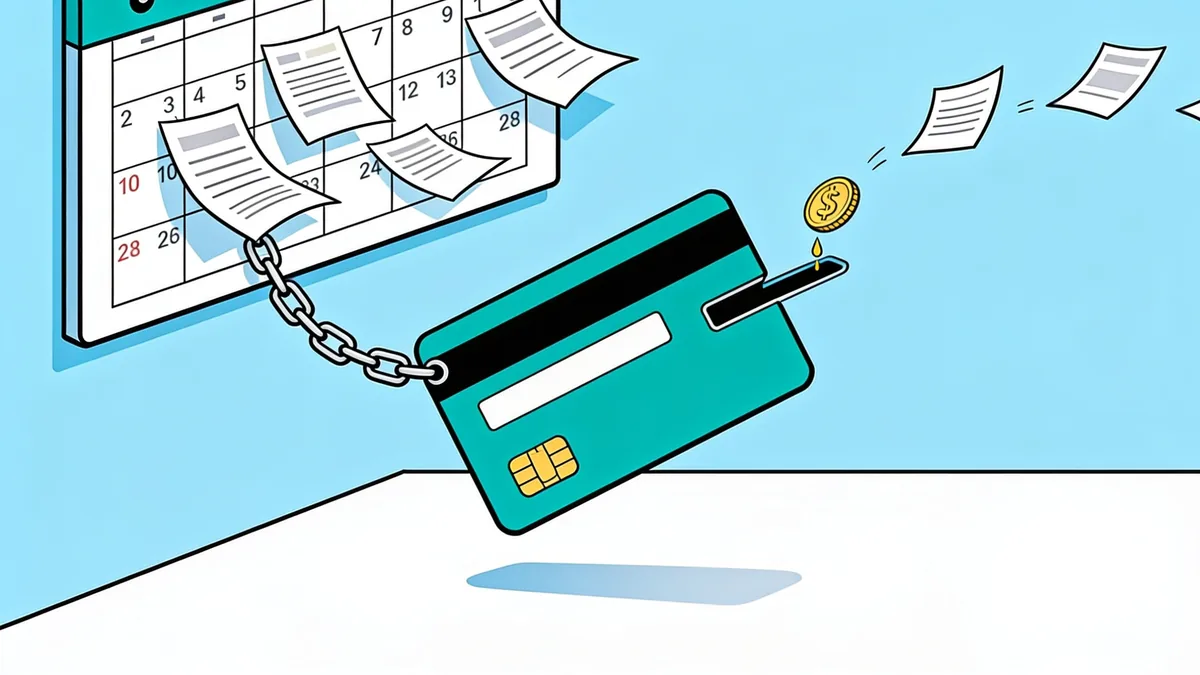
Read the top row again: paying the percent-style minimum, the interest ends up costing nearly twice the original balance, and the card outlives most mortgages. Doubling the payment to $400 cuts the timeline by roughly 80%. This is why every serious payoff plan starts with the same move: fix your payment as a dollar amount and never let it shrink as the balance falls. Since credit cards are revolving credit, the balance only falls if new spending stops too, so the card that’s being attacked should stay out of your wallet.
Should you consolidate or use a balance transfer?
Consolidation tools don’t erase debt; they reprice it. Used well, they lower the interest so more of your fixed payment hits principal. Used badly, they free up empty cards that fill right back up. Here’s the honest comparison:
| Option | Best for | Watch out for |
|---|---|---|
| 0% balance transfer card | Card debt you can clear in 12 to 21 months | 3 to 5% transfer fee; the regular APR returns when the promo ends |
| Consolidation loan | Several high-rate debts, fixed payoff date wanted | Rate depends on your credit; longer terms can cost more overall |
| HELOC / home equity | Large balances at a much lower rate | Your home becomes the collateral for old card debt |
| Nonprofit debt management plan | Struggling with minimums, want one payment | Monthly fee; some cards get closed, which can raise utilization |
Two quick notes on credit. Your credit utilization, the share of your card limits you’re using, drops when balances move to an installment loan, which usually helps your score within a few months. And a transfer only wins if the fee is smaller than the interest you’d otherwise pay, which you can check in a minute with a loan payoff comparison. If most of your balance sits on cards specifically, our guide on paying off credit card debt walks through the card-only version of this decision.
How do you stay out of debt once you’re free?
The last debt payment is a dangerous moment: $1,000 a month suddenly has no job, and unassigned money drifts back into old habits. Give it a new job the same week.
- Finish the emergency fund. Grow the $1,000 starter buffer to 3 to 6 months of expenses. This is the wall between you and the next balance.
- Keep the paid-off cards open. Available credit with zero balance keeps your utilization low. Put one small recurring charge on each and autopay in full.
- Start sinking funds. Car repairs, holidays, and annual insurance premiums aren’t emergencies, they’re schedules. Save for them monthly so they never touch a card.
- Point the attack amount at growth. The same $1,000 that killed $26,200 of debt in 31 months becomes a serious investment habit; even part of it, compounding for a decade, outgrows what the debt ever cost.
Getting out of debt is a math problem wrapped in a behavior problem. The math says avalanche, the behavior says snowball, and the hybrid says you don’t have to pick a side. Whichever order you choose, the household in our example wins by 22 months and thousands of dollars simply because it chose one. List your debts, fix your payment, pick your target, and let the debt snowball calculator show you the exact month you’re done.
Frequently asked questions
Pick one payoff order and feed it every spare dollar. List your debts, pay minimums on everything, then send all extra money to a single target: the smallest balance (snowball) or the highest APR (avalanche). In our worked example, that one change cut the payoff time from 53 months to 31 and saved over $4,400 in interest compared with paying minimums alone.
Payday loans and other triple-digit APR debt always come first. After that, it's your choice of system: the avalanche targets your highest interest rate and saves the most money, while the snowball targets your smallest balance and gives you the fastest win. Secured, low-rate debts like auto loans and mortgages usually stay on schedule until the expensive debt is gone.
Build a small starter emergency fund first, around $1,000, so a surprise bill doesn't land back on a credit card. Once that buffer exists, high-interest debt beats saving: a card charging 24% costs far more than any savings account pays. After the expensive debt is gone, redirect those payments into a 3 to 6 month emergency fund.
The system is the same, just smaller. Cover every minimum payment first, protect a small cash buffer, and send whatever extra exists, even $25 a month, at one target debt. Call lenders about hardship plans, ask medical providers for interest-free payment plans, and check whether income-driven repayment applies to federal student loans. Progress compounds once the first balance clears.
Usually not. Closing a card shrinks your available credit, which raises your credit utilization and can lower your score. Keeping paid-off cards open with a zero balance does the opposite. If an annual fee bothers you or the card tempts you to spend, ask the issuer for a downgrade to a no-fee version before closing it.
There's a small, short-lived dip from the hard inquiry and the new account. After that, consolidation often helps: your revolving card balances drop to zero, utilization falls, and one fixed payment is easier to keep on time. The risk isn't the loan itself, it's running the emptied cards back up while the loan is still open.
It depends on the balance, the rates, and how much you pay beyond the minimums. The four-debt household in our example, with $26,200 owed, went debt-free in 31 months at $1,000 a month but would've needed 53 months paying only minimums. Run your own balances through a payoff calculator to see your date, then test how $50 or $100 more changes it.
Calcowa's editorial team builds and checks every calculator against published formulas, then writes these guides so the numbers make sense. Each tool shows its formula and a worked example. See our methodology.
Related guides
How Much House Can I Afford? The Real Math
How much house can I afford? Read your answer from a salary table, compare the 28/36 rule with three others, and see the real monthly cost before you buy.
FinanceHow to Pay Off Your Auto Loan Faster
How to pay off your auto loan faster: five strategies tested on one $28,000 loan, with tables showing how many months and how much interest each one saves.
FinanceHow to Pay Off Credit Card Debt Fast
How do you pay off credit card debt fast? Compare the snowball and avalanche methods with a real worked example, and see which clears your cards sooner.