
How Much House Can I Afford? The Real Math
How much house can I afford? Read your answer from a salary table, compare the 28/36 rule with three others, and see the real monthly cost before you buy.

Short answer: most buyers can comfortably afford a home priced so the full monthly payment stays near 28% of gross income, which works out to roughly $175,000 to $205,000 on a $60,000 salary and $306,000 to $358,000 on $100,000, at a 6.75% rate. Asking how much house can I afford is really two questions: what will a lender approve, and what can you actually pay every month without wincing? Those numbers are often $100,000 apart. This guide gives you a salary-to-price table you can read your answer from, compares four affordability rules on the same income, and breaks down the costs that don’t show up in the sticker payment.
If you’d rather test your own numbers directly, the mortgage payment tool turns any price, rate, and down payment into a monthly figure in seconds.
How much house can I afford on my salary?
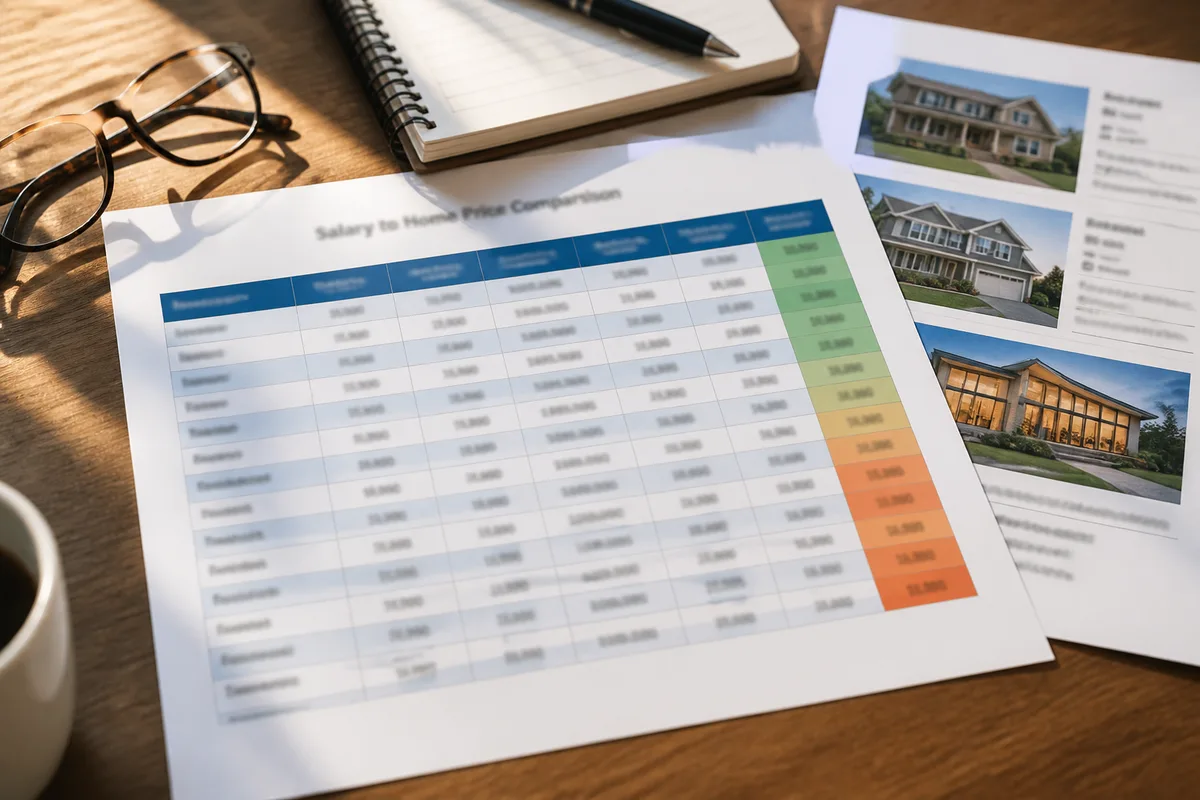
Here’s the table the rest of this article builds on. It applies the 28% front-end rule: your full housing payment, including principal, interest, property taxes, insurance, and PMI when you put down less than 20%, stays at or under 28% of gross monthly income. Assumptions: 30-year fixed at 6.75%, property tax at 1.1% of home value, $150 a month for insurance, and 0.5% annual PMI on low-down-payment loans. Your county’s taxes will shift these numbers, which is exactly why the last section shows you how to rerun them.
| Annual salary | Housing budget (28%) | Max price, 10% down | Max price, 20% down |
|---|---|---|---|
| $40,000 | $933/mo | $110,000 | $128,000 |
| $50,000 | $1,167/mo | $143,000 | $167,000 |
| $60,000 | $1,400/mo | $175,000 | $205,000 |
| $75,000 | $1,750/mo | $224,000 | $262,000 |
| $80,000 | $1,867/mo | $241,000 | $281,000 |
| $100,000 | $2,333/mo | $306,000 | $358,000 |
| $125,000 | $2,917/mo | $388,000 | $453,000 |
| $150,000 | $3,500/mo | $470,000 | $549,000 |
| $200,000 | $4,667/mo | $634,000 | $740,000 |
Two things jump out. First, the down payment matters more than most buyers expect: at every income level, 20% down buys roughly 17% more house for the same monthly budget, because you’re borrowing less and skipping PMI. Second, these are comfort numbers, not approval ceilings. A lender running the same $100,000 salary might approve $450,000 or more, and nothing about that approval means the payment will feel fine alongside daycare, car repairs, and retirement savings.
One caution: the table uses gross salary because lenders do, but your budget lives on take-home pay. Check your actual monthly net with the take-home pay tool before you anchor on a row.
What is the 28/36 rule?
The 28/36 rule is the oldest yardstick in mortgage lending, and it has two halves. The front-end ratio says your housing payment, everything in PITI, shouldn’t top 28% of gross monthly income. The back-end ratio says all your monthly debt obligations combined, the house plus car payments, student loans, personal loans, and credit card minimums, shouldn’t top 36%.
On an $80,000 salary, gross monthly income is $6,667. The rule caps housing at $1,867 and total debt at $2,400. Notice the gap: only $533 of room for everything else. A $450 car payment plus $150 in card minimums eats that entirely, and at that point the back-end ratio, not the front-end one, decides what you can borrow.
That’s the part most first-time buyers miss. The question isn’t only what payment fits your income, it’s what payment fits next to the debts you already carry. Knock out a card balance before applying and you often add more buying power than a year of saving would. We’ve covered the fastest routes in how to pay off credit card debt if that’s the lever you need to pull first.
Is 28/36 conservative? By modern underwriting standards, yes. Lenders routinely approve back-end ratios of 45%, sometimes 50%. The rule survives because it describes the payment people actually live with comfortably, not the payment they can technically clear each month.
How do the four affordability rules compare?
Different experts hand you different rules, and they produce wildly different answers. Nobody shows you how far apart they land, so here are all four applied to the same buyer: $80,000 salary, about $5,000 a month take-home, $500 in existing debt payments, 6.75% rate.
| Rule | Monthly housing budget | Max home price | Character |
|---|---|---|---|
| 3x annual income | ~$1,861 (result, not input) | $240,000 | Quick estimate |
| 28/36 rule (10% down) | $1,867 | $241,000 | Balanced guideline |
| Lender max, 45% back-end (10% down) | $2,500 | $330,000 | Approval ceiling |
| 25% of take-home, 15-year loan, 20% down | $1,250 | $138,000 | Strictest (Ramsey method) |
The spread is enormous: $138,000 to $330,000 for the same person. The 25% take-home method popular with debt-focused advisors uses a 15-year loan and a 20% down payment, which is why its number looks shocking next to the others. The lender maximum sits at the other extreme, and it’s worth saying plainly: that $330,000 approval would put this buyer’s total debt at 45% of gross income, which is roughly 60% of take-home pay committed before groceries.
Where should you land? For most buyers the 28/36 row is the sane middle. Stretch toward the lender max only when your income is rising fast or your other costs are unusually low. Drop toward the strict row when your income is variable or you’re carrying obligations, like daycare, that ratios never see.
How does your debt-to-income ratio change the answer?
Debt-to-income ratio, or DTI, is the single number underwriters care about most. It’s your total monthly debt payments divided by gross monthly income, and every loan program caps it differently:
| Loan type | Front-end guideline | Back-end limit | Notes |
|---|---|---|---|
| Conventional | ~28% traditional | 45%, up to 50% with strong credit | PMI under 20% down |
| FHA | 31% standard | 43%, up to ~50% with compensating factors | 3.5% down, mortgage insurance for loan life |
| VA | No fixed cap | ~41% guideline | Residual income test matters more |
| USDA | 29% | 41% | Rural areas, income limits apply |
Run your own numbers once and the mechanics get obvious. Say you earn $7,000 a month gross with a $400 car payment and $200 in student loans. At a 45% back-end cap, $3,150 can go to debt, minus the $600 you’re already committed to, leaving $2,550 for housing. Erase the car payment and the same math frees $2,950, which is tens of thousands of dollars in extra price room.
That’s why the cheapest way to buy more house is usually to retire a debt, not to save a bigger down payment. If your ratios are tight, a structured payoff plan like the one in how to get out of debt moves the needle faster than almost anything else, and it helps your credit score, which sets your rate, at the same time.
One honest warning in the other direction: qualifying DTI ignores expenses that aren’t debts. Childcare, health premiums deducted outside payroll, tithing, aging parents. Underwriting doesn’t see any of it. You have to.
What does a mortgage payment really include?
The payment a listing site shows you is principal and interest. The payment you’ll actually make is PITI plus extras, and the gap is not small. Here’s a $350,000 home with 10% down at 6.75%, line by line:
| Line item | Monthly cost | Often forgotten? |
|---|---|---|
| Principal & interest ($315,000 loan) | $2,043 | No, this is the sticker |
| Property taxes (1.1%) | $321 | Sometimes |
| Homeowners insurance | $150 | Sometimes |
| PMI (0.5% of loan) | $131 | Usually |
| Lender-counted total (PITI + PMI) | $2,645 | |
| Maintenance reserve (1% of value/yr) | $292 | Almost always |
| Real monthly cost | $2,937 |
The sticker payment is $2,043. The real number is $2,937, which is 44% higher. Lenders qualify you on the $2,645 line, but the roof, the water heater, and the HVAC don’t care about underwriting rules, and the 1% annual maintenance rule of thumb is if anything gentle for older homes. HOA dues, where they exist, stack on top of all of it and get counted in your DTI too.
Closing costs deserve a line too: plan on 2% to 5% of the purchase price in cash at the table, on top of your down payment. On this home, that’s $7,000 to $17,500.
Before you fall in love with a listing, run its real numbers through the monthly payment estimator with your local tax rate, then add the maintenance line yourself.
How much do interest rates change what you can afford?
More than any other single variable. Take a fixed $2,000 a month for principal and interest on a 30-year loan and watch what happens as the rate moves:
| Rate | Loan your $2,000/mo supports | Price at 10% down |
|---|---|---|
| 5.0% | $372,600 | $414,000 |
| 5.5% | $352,200 | $391,400 |
| 6.0% | $333,600 | $370,600 |
| 6.5% | $316,400 | $351,600 |
| 7.0% | $300,600 | $334,000 |
| 7.5% | $286,000 | $317,800 |
| 8.0% | $272,600 | $302,900 |
Every full point of rate costs you roughly 10% of your buying power. Between 5% and 8%, the same budget loses $111,000 of house. That has two practical uses. First, it explains why affordability advice from 2021, when rates sat near 3%, reads like fantasy now. Second, it tells you what a rate improvement is worth to you personally: moving from 7.5% to 6.75% through credit repair, shopping three or more lenders, or paying discount points buys the same house for about $140 less per month.
Rate shopping is the underused one: applications within a two-week window count as a single credit inquiry, and comparing even three lenders reliably saves thousands over the loan’s life.
How much should you put down?
The table in the first section showed 10% versus 20%. Here’s the full picture on that same $350,000 home at 6.75%, from minimum-down programs to the classic twenty:
| Down payment | Cash needed | Loan | P&I | PMI | Full PITI |
|---|---|---|---|---|---|
| 3% ($10,500) | $10,500 | $339,500 | $2,202 | $141 | $2,814 |
| 3.5% FHA ($12,250) | $12,250 | $337,750 | $2,191 | $141+ | $2,802+ |
| 5% ($17,500) | $17,500 | $332,500 | $2,157 | $139 | $2,766 |
| 10% ($35,000) | $35,000 | $315,000 | $2,043 | $131 | $2,645 |
| 20% ($70,000) | $70,000 | $280,000 | $1,816 | $0 | $2,287 |
Note the FHA row carries a plus sign: FHA mortgage insurance runs higher than the conventional PMI shown and usually lasts the life of the loan, plus a 1.75% upfront premium. That’s the price of its easier qualifying.
The honest takeaway isn’t “always put 20% down.” Waiting years to save $70,000 while prices and rents climb can cost more than PMI ever would, and conventional PMI drops off automatically at 22% equity. The real rule is to keep an emergency fund out of the deal: a buyer with 10% down and six months of expenses saved is in far better shape than one with 20% down and an empty account.
What can you do if homes near you are out of reach?
Run the salary table against a high-cost metro and the numbers simply don’t meet. When that’s your situation, you have more moves than “save harder”:
- Attack the back-end ratio. Clearing a $400 car payment adds roughly $50,000 to $65,000 of price room at current rates. It’s the fastest lever that’s fully in your control.
- Buy the rate down or shop harder for it. As the rate table showed, 0.75% off the rate is worth about 7% more house on the same payment.
- Widen the search ring. Property tax rates alone swing affordability by 20% or more between neighboring counties on the same income.
- Consider house hacking. A duplex where a tenant covers part of the payment, or a home with a rentable basement, changes the qualifying math, and FHA allows 3.5% down on properties up to four units.
- Look at first-time buyer programs. State housing agencies offer down payment assistance and below-market rates that stack with the strategies above.
- Rent on purpose, not by default. In some metros renting and investing the difference genuinely wins for years at a stretch. The rent versus buy comparison puts real numbers on that choice instead of a vibe.
What you shouldn’t do is close the gap by stretching to the lender’s approval ceiling. A payment at 45% of gross income leaves no room for a rate-shocked insurance renewal or a job wobble.
Your next step takes five minutes: pick your row from the salary table, subtract your existing debts using the 36% test, and run the resulting price through the payment calculator with your county’s actual tax rate. The number that survives all three checks is how much house you can afford.
Frequently asked questions
Roughly $306,000 with 10% down or $358,000 with 20% down, using the 28% rule at a 6.75% rate with typical taxes and insurance. That keeps your full housing payment near $2,333 a month. Lenders may approve considerably more, sometimes $450,000 or beyond, but the approval ceiling assumes you'll dedicate up to 45% of gross income to debt, which leaves little room for saving or setbacks.
It's a budgeting guideline lenders have used for decades. Your housing payment, meaning principal, interest, taxes, and insurance combined, should stay at or under 28% of your gross monthly income. All your debt payments together, including the house, car loans, student loans, and card minimums, should stay under 36%. On an $80,000 salary that caps housing at $1,867 a month and total debt at $2,400.
If the full $2,000 goes to principal and interest on a 30-year loan, it supports about a $334,000 purchase at 7% with 10% down, or about $370,600 at 6%. Taxes, insurance, and any PMI come on top, so a $2,000 all-in budget buys meaningfully less, usually somewhere in the $240,000 to $270,000 range depending on your local tax rate.
About $111,000 a year with 20% down, or about $129,000 with 10% down, based on the 28% rule at a 6.75% rate with typical taxes, insurance, and PMI. The full monthly payment runs near $2,592 with 20% down and $3,002 with 10% down. A higher rate, a high-tax county, or HOA dues all push the required income up from there.
It's a decent first filter at today's rates. Three times an $80,000 salary is $240,000, and with 10% down at 6.75% that lands almost exactly on the 28% front-end guideline. It falls apart when rates move: at 5% the same salary safely supports closer to 3.5x, and at 8% barely 2.7x. It also ignores your other debts, so treat it as a starting estimate, not an answer.
Often a somewhat higher price than a conventional loan allows, because FHA underwriting accepts debt-to-income ratios up to about 50% with compensating factors and requires just 3.5% down. The tradeoff is cost: you'll pay an upfront mortgage insurance premium of 1.75% of the loan plus annual mortgage insurance that usually lasts the life of the loan, which raises the monthly payment on the same house.
Yes. Lenders qualify you on the full PITI payment: principal, interest, taxes, and insurance, plus PMI and HOA dues where they apply. That's why two identical salaries can afford very different homes in different counties. A 2% property tax rate consumes roughly $580 a month of budget on a $350,000 home that a 0.5% county would leave available for the loan itself.
Calcowa's editorial team builds and checks every calculator against published formulas, then writes these guides so the numbers make sense. Each tool shows its formula and a worked example. See our methodology.
Related guides
How to Pay Off Your Auto Loan Faster
How to pay off your auto loan faster: five strategies tested on one $28,000 loan, with tables showing how many months and how much interest each one saves.
FinanceHow to Get Out of Debt: A Realistic Plan
How to get out of debt with a plan that actually sticks: six steps, a real four-debt example, and snowball vs avalanche vs hybrid numbers side by side.
FinanceHow to Pay Off Credit Card Debt Fast
How do you pay off credit card debt fast? Compare the snowball and avalanche methods with a real worked example, and see which clears your cards sooner.