
How Much Paint Do I Need for a Room?
How much paint do I need? Most rooms take 2 gallons for two coats of wall paint. Get the formula, gallons-by-room-size charts, and ceiling and trim math.
Short answer: how much paint do I need for an average room? Two gallons covers a typical 12x12 bedroom with two coats, and most rooms land between one and three gallons. The real number depends on your wall area, the paint’s coverage rate (350 to 400 square feet per gallon), and how many coats you’ll apply. Below you’ll find the exact formula, gallon charts for eight common room sizes, and the ceiling, trim, and door math that most guides skip.
Don’t feel like doing arithmetic? The paint estimator takes your room dimensions and coats and returns gallons in a couple of seconds.
How much paint does an average room take?
Most bedrooms and offices need 2 gallons for walls at two coats. Living rooms usually take 3, and a small bathroom often squeaks by on 1. Those numbers assume 8-foot ceilings, smooth previously painted walls, and paint that covers 350 square feet per gallon.
Here’s the fast lookup before we get into the math:
| Room | Typical size | Walls, 2 coats |
|---|---|---|
| Bathroom | 6x8 ft | 1 gallon |
| Bedroom | 12x12 ft | 2 gallons |
| Master bedroom | 14x16 ft | 2 to 3 gallons |
| Living room | 16x20 ft | 3 gallons |
Buy the higher amount when you’re changing colors dramatically or the walls drink paint (bare drywall, plaster patches, heavy texture). Returns cost you a trip; running out costs you a trip plus a visible lap line where the first batch dried.
How do you calculate how much paint you need?
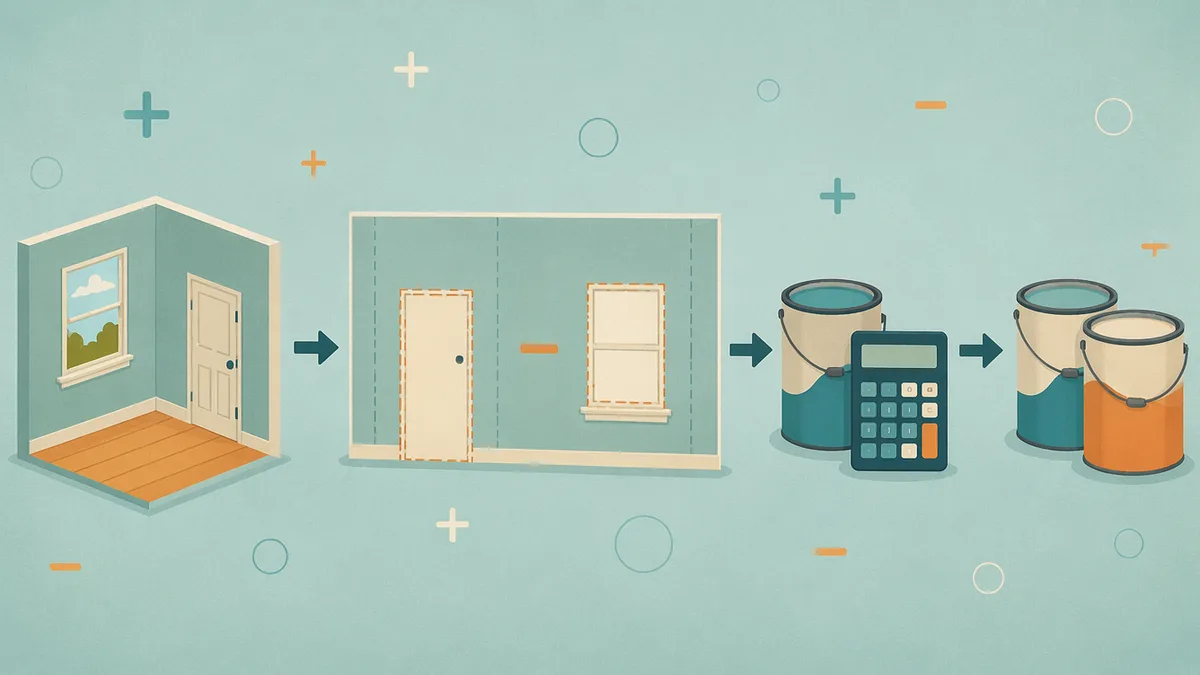
Multiply your room’s perimeter by its ceiling height, subtract doors and windows, then divide by the paint’s coverage rate and multiply by your number of coats. That’s the whole method. Four steps, one worked example:
Step 1: find the wall area. Add up the length of all four walls, then multiply by ceiling height. For a 12x12 room with 8-foot ceilings: (12 + 12 + 12 + 12) x 8 = 48 x 8 = 384 square feet. Odd-shaped room? Measure each wall separately, or let the square footage tool total it for you.
Step 2: subtract openings. A standard door is about 20 square feet and a window about 15. One of each: 384 - 20 - 15 = 349 square feet of paintable wall.
Step 3: divide by coverage. Most interior paints cover 350 to 400 square feet per gallon on smooth, sealed walls. Using the conservative 350: 349 / 350 = 1.0 gallon per coat.
Step 4: multiply by coats. Two coats is the standard for even color and proper durability, so 1.0 x 2 = 2 gallons. Done.
Pros pad that result by about 10 percent for roller waste, paint left in the tray, and future touch-ups. On a 2-gallon job the padding fits inside the second gallon, so you don’t need to buy extra. On bigger jobs, round up to the next gallon rather than buying exact.
Want the same math without a pencil? Enter your room dimensions and the tool handles openings, coats, and rounding.
How much does a gallon of paint cover?
One gallon of interior wall paint covers 350 to 400 square feet per coat on a smooth, previously painted surface. That’s the number printed on nearly every can, and it’s reliable when the wall is in good shape. Surface condition changes it fast, because porous and textured surfaces pull paint in and hold more of it.
| Surface | Coverage per gallon | Why it differs |
|---|---|---|
| Smooth, previously painted drywall | 350 to 400 sq ft | Sealed surface, paint sits on top |
| Lightly textured (orange peel) | 300 to 350 sq ft | More surface area per square foot |
| Heavy texture (knockdown, popcorn) | 250 to 300 sq ft | Peaks and valleys add 20%+ area |
| Bare drywall, no primer | 200 to 300 sq ft | Paper and mud absorb the first coat |
| Primer on bare drywall | 200 to 300 sq ft | Made to soak in and seal |
| Rough stucco or masonry | 150 to 250 sq ft | Extremely porous, drinks paint |
Because texture eats coverage, a textured 12x12 room can need a full extra gallon compared with the same room in smooth drywall. When in doubt, calculate at 300 square feet per gallon instead of 350. The difference costs a few dollars; the mid-wall shortage costs an afternoon.
Paint needed by room size
The chart below answers the question the formula answers, but for the eight most common US room sizes at once. It assumes 8-foot ceilings, one door, one window, and 350 square feet per gallon of coverage. Gallons are rounded up to buying quantities, with quarts shown where a full gallon would be wasteful.
| Room size | Wall area (after openings) | 1 coat | 2 coats |
|---|---|---|---|
| 8x10 ft | 253 sq ft | 3 quarts | 2 gallons |
| 10x10 ft | 285 sq ft | 1 gallon | 2 gallons |
| 10x12 ft | 317 sq ft | 1 gallon | 2 gallons |
| 12x12 ft | 349 sq ft | 1 gallon | 2 gallons |
| 12x14 ft | 381 sq ft | 1.5 gallons | 2.5 gallons |
| 14x16 ft | 445 sq ft | 1.5 gallons | 3 gallons |
| 16x20 ft | 541 sq ft | 2 gallons | 3.5 gallons |
| 20x20 ft | 605 sq ft | 2 gallons | 4 gallons |
Three notes on reading it. Rooms with more than one door or window need less paint, so a 12x12 with two windows drops about 15 square feet, which rarely changes the gallon count. Nine-foot ceilings add 12.5 percent to every wall figure, which pushes the 14x16 and larger rooms up a half gallon. And open floor plans should be measured as one continuous perimeter rather than as separate rooms, since there’s no wall between them to skip.
How much paint do I need for ceilings, trim, and doors?
Plan on 1 gallon of ceiling paint per 350 to 400 square feet of floor, 1 quart of trim paint per 250 linear feet of baseboard, and 1 gallon of trim paint for every 6 to 8 doors. Wall charts never include these, and they’re the difference between finishing Saturday and driving back to the store Sunday morning.
| Surface | Coverage rule | Typical 12x12 room needs |
|---|---|---|
| Ceiling | Floor area / 350 per coat | 1 gallon (2 coats, 144 sq ft x 2 = 288) |
| Baseboards | 1 quart per 250 linear ft per coat | 1 quart covers 2 coats of 48 ft |
| Door + frame | ~100 sq ft per door, both sides | 1 quart per door (2 coats) |
| Window trim | ~10 sq ft per window | Included in the baseboard quart |
| Crown molding | Same as baseboard | Add to linear feet total |
Ceilings almost always need two coats because flat ceiling paint touches up poorly and roller lines show in raking light. A gallon handles both coats in any room up to about 13x13. For trim, one gallon covers 6 to 8 full doors with frames, which is why whole-house trim jobs usually buy a single gallon of semi-gloss and still have some left.
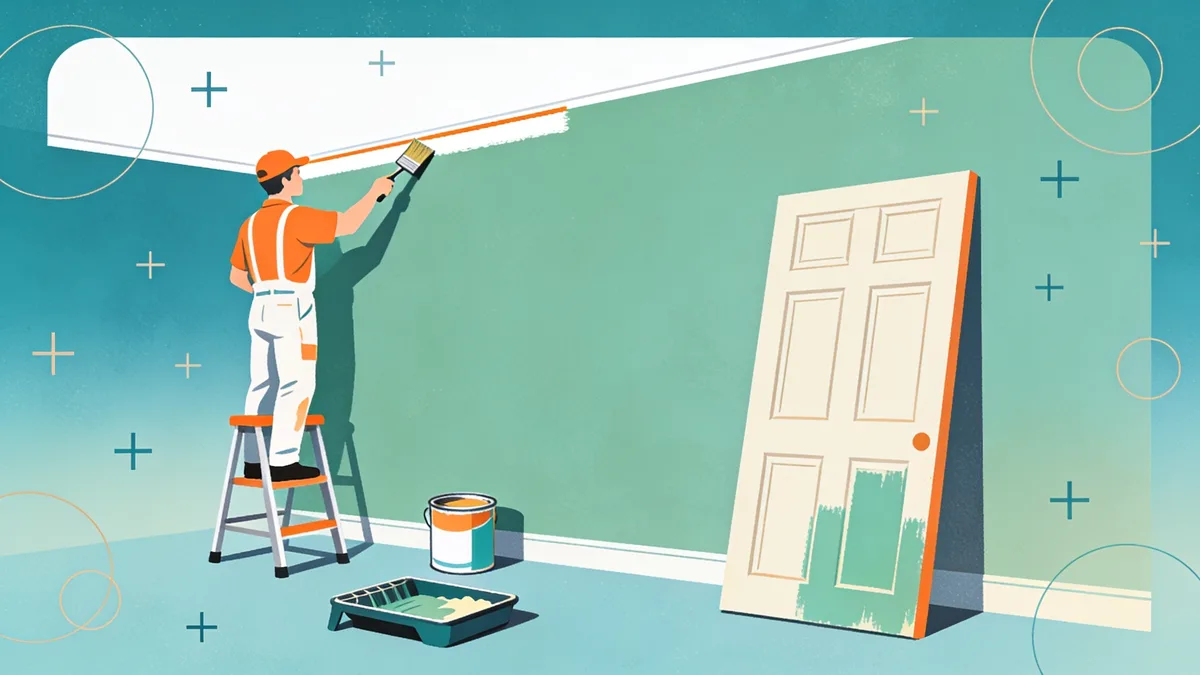
Trim and ceiling paint aren’t interchangeable with wall paint. Ceiling formulas are flatter and drip less overhead, while trim paints level out brush marks and cure harder. Buying them as separate line items keeps your wall math clean.
Which paint can sizes should you buy?
Buy quarts for accent walls and doors, gallons for single rooms, and 5-gallon buckets once a job crosses about 4 gallons. Matching can size to job size is where most of the savings hide, because per-gallon price falls as the container grows.
| Can size | Covers per coat | Typical 2026 price | Best for |
|---|---|---|---|
| Sample (8 oz) | ~25 sq ft | $5 to $8 | Testing colors on the wall |
| Quart | 90 to 100 sq ft | $15 to $25 | One door, accent wall, touch-ups |
| Gallon | 350 to 400 sq ft | $20 to $90 | One room per 2 gallons |
| 5-gallon bucket | 1,750 to 2,000 sq ft | 10 to 15% less per gallon | Whole floors, open plans, exteriors |
A 5-gallon bucket weighs 50 to 60 pounds, so factor the carry before you order one for a third-floor walkup. There’s also a consistency bonus: paint mixed in one bucket can’t have tint drift between cans, which matters with deep colors where two machine-tinted gallons can land a shade apart. Painters call the fix “boxing”, pouring all cans into one bucket, and a 5-gallon purchase skips the step entirely.
One warning on samples. Don’t judge from the can lid or a paper swatch; brush the 8-ounce sample on two walls, one sunny and one shaded, and look at it morning and night before committing to gallons.
What makes a room need more paint?
Dark-to-light color changes, bold saturated colors, texture, bare surfaces, and sheen switches all push your gallon count up. Each factor on its own can add a coat, and a coat is another full round of your per-coat gallon figure.
| Situation | Extra paint needed | Cheaper fix |
|---|---|---|
| Covering dark walls with light paint | +1 to 2 coats | One coat of gray-tinted primer |
| Deep reds, oranges, yellows | +1 to 2 coats | Tinted primer matched to topcoat |
| Bare drywall or fresh patches | +30 to 50% on first coat | PVA drywall primer first ($15 to $20) |
| Textured walls | +20% area | Calculate at 300 sq ft per gallon |
| Glossy existing walls | Adhesion risk, not volume | Scuff sand, then bonding primer |
| Same color refresh, good walls | Sometimes 1 coat only | Buy half, test a wall |
Primer is the recurring answer because it’s cheaper than paint and exists to solve exactly these problems. Covering burgundy with white using paint alone can take 4 coats; one $18 coat of tinted primer plus 2 topcoats gets there with less labor and less money. Paint-and-primer-in-one products handle mild color shifts on sealed walls, but they don’t replace real primer on bare drywall, stains, or drastic changes, whatever the label implies.
How much extra paint should you buy?
Add about 10 percent to your calculated total, then keep a labeled quart of leftover per color for touch-ups. That buffer absorbs roller and tray waste, second passes on cut-in lines, and the patch you’ll scuff moving furniture back in.
Store leftovers well and they’ll match for 2 to 5 years. Pour what’s left into a clean quart can or airtight jar (less air means slower skinning), label it with the room, brand, color name, and sheen, and keep it somewhere that doesn’t freeze. A garage that hits 20°F in January will ruin latex paint in one winter, since freezing breaks the emulsion.
Over-bought badly? US retailers generally take back unopened, untinted cans with a receipt, though custom-tinted gallons are yours to keep. For those, PaintCare runs free drop-off recycling sites in 12 states plus DC, and many Habitat for Humanity ReStores accept usable paint donations.
Before you head to the store, run your room through the gallon estimator once more with your real measurements. Two minutes of measuring beats a second trip, and your walls won’t care that the math was easy.
Frequently asked questions
A 12x12 room with 8-foot ceilings has about 384 square feet of wall area before openings. Subtract a door (20 sq ft) and a window (15 sq ft) and you're near 349 square feet. At 350 square feet per gallon, that's one gallon per coat, so buy two gallons for the standard two coats. If the walls are textured or you're covering a dark color, a third gallon is cheap insurance.
Only for one coat in a small bedroom. One gallon covers 350 to 400 square feet, which matches the wall area of roughly a 10x12 room with 8-foot ceilings. Since almost every repaint needs two coats for even color, plan on two gallons for a typical bedroom and keep the leftover for touch-ups.
Two coats is the default for walls, even with paint-and-primer products. One coat only works when you're repainting the same color on smooth, sealed walls in good condition. Going from dark to light, painting bare drywall, or using deep reds, oranges, and yellows can push you to three coats plus a tinted primer.
In 2026, budget interior lines run $20 to $30 per gallon, mid-range lines $35 to $55, and premium lines $60 to $90. Five-gallon buckets of the same paint usually cost 10 to 15 percent less per gallon. Primer is cheaper, typically $15 to $30 per gallon.
One litre of wall paint covers roughly 90 to 110 square feet per coat, which is about 8.5 to 10 square meters. That's a quarter of a US gallon's coverage, since a gallon is 3.785 litres and covers 350 to 400 square feet. Metric can sizes of 2.5 litres cover around 240 square feet per coat.
A 5-gallon bucket of latex paint weighs 50 to 60 pounds, with most landing near 56 pounds. A single gallon weighs about 11 pounds. Weight matters if you're hauling paint upstairs or ordering delivery, and it drops as the paint dries since roughly half that weight is water.
Measure the wall's width times its height. A typical 12-foot wall with 8-foot ceilings is 96 square feet, so a single quart (which covers about 90 to 100 square feet) handles one coat with little to spare. Accent walls in bold colors usually want two coats, so one gallon is the safer buy and leaves plenty for touch-ups.
Calcowa's editorial team builds and checks every calculator against published formulas, then writes these guides so the numbers make sense. Each tool shows its formula and a worked example. See our methodology.
Related guides
How Much Gravel Do I Need? Coverage Chart
How much gravel do I need? A 10x10 patio base at 4 inches takes 1.23 cubic yards, about 1.7 tons. Get the formula, coverage charts, and ton conversions.
ConstructionHow Many Tiles Do I Need? (with Waste Factor)
How many tiles do I need? A 10x10 room takes 110 twelve-inch tiles with waste included. Get the formula, waste factors by layout, and box counts by size.
ConstructionHow Much Concrete Do I Need? Formula and Chart
How much concrete do I need? A 10x10 slab at 4 inches takes 1.23 cubic yards, about 56 bags of 80 lb mix. Get the formula, yardage charts, and bag counts.