
How Much Gravel Do I Need? Coverage Chart
How much gravel do I need? A 10x10 patio base at 4 inches takes 1.23 cubic yards, about 1.7 tons. Get the formula, coverage charts, and ton conversions.
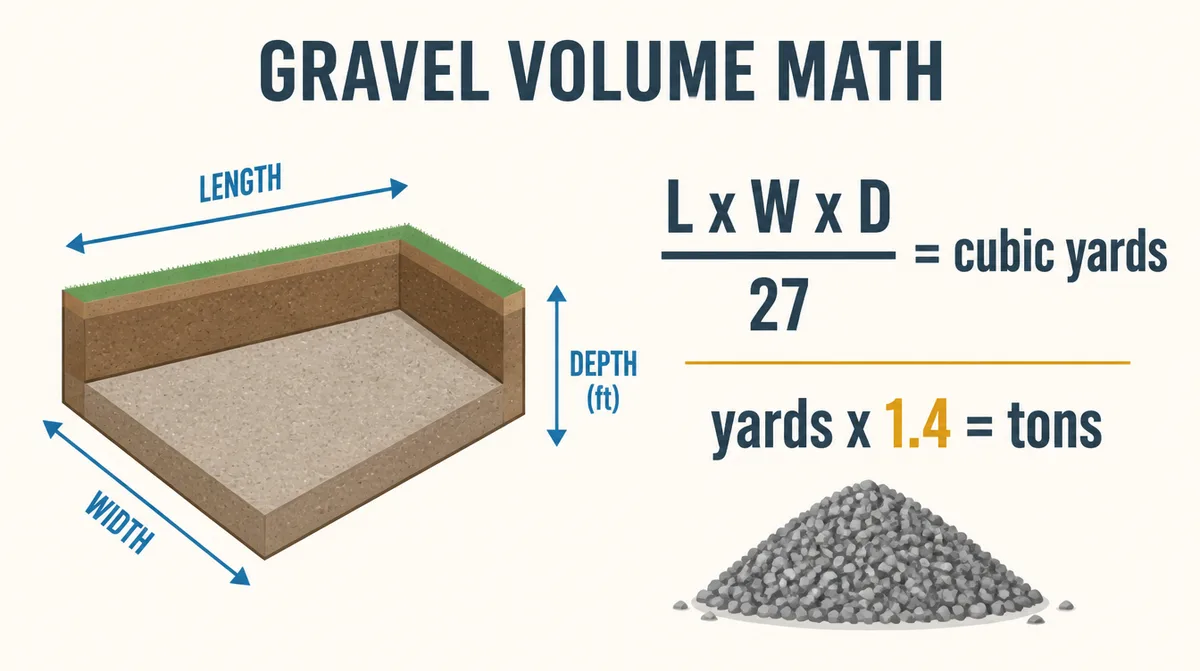
Short answer: how much gravel do I need for a typical project? A 10x10 patio base at 4 inches deep takes 1.23 cubic yards, which is about 1.7 tons. Most garden paths need under a yard, most patio bases 1 to 2 yards, and a new gravel driveway 10 to 20 yards across its layers. The formula behind every one of those numbers: length x width x depth, divided by 27 for cubic yards, then times 1.4 for tons. Below you’ll find that math worked step by step, coverage charts for both yards and tons, depth guidance by project, and the bag-versus-bulk price math nobody puts in one place.
Want the answer without the arithmetic? The gravel estimator takes your dimensions and returns cubic yards, tons, and a waste allowance in seconds.
How much gravel do I need for common projects?
Here’s the lookup chart before the formula. Depths follow standard practice for each job, volumes are raw, and tons use the 1.4 conversion for common crushed gravel. Add 10 percent when you order, for settling and low spots.
| Project | Depth | Cubic yards | Tons |
|---|---|---|---|
| Garden path, 3x20 ft | 3 in | 0.56 | 0.8 |
| French drain, 25 ft trench (1 ft wide, 1 ft deep) | 12 in | 0.93 | 1.3 |
| Patio base, 10x10 ft | 4 in | 1.23 | 1.7 |
| Pea gravel seating area, 12x12 ft | 3 in | 1.33 | 1.9 |
| Driveway top-up, single car (12x25 ft) | 2 in | 1.85 | 2.6 |
| Driveway top-up, two car (20x25 ft) | 2 in | 3.09 | 4.3 |
| Play area, 15x15 ft | 9 in | 6.25 | 8.7 |
| New driveway, single car (12x25 ft, 3 layers) | 12 in | 11.1 | 15.6 |
| New driveway, two car (20x25 ft, 3 layers) | 12 in | 18.5 | 25.9 |
Two patterns worth noticing. First, depth drives the number as hard as footprint does: the same 12x25 driveway needs 1.85 yards as a refresh but 11 yards as a new build. Second, anything past 2 or 3 yards moves you out of bag territory and into a bulk delivery, and the bags-versus-bulk section below shows exactly where that line sits.
How do you calculate gravel in cubic yards?
Multiply length by width by depth to get cubic feet, then divide by 27. The one trap is units: depth must be in feet, so divide the inches by 12 first. Here’s the full method on a 10x10 patio base at 4 inches:
Step 1: convert depth to feet. 4 inches / 12 = 0.333 feet.
Step 2: multiply the three dimensions. 10 x 10 x 0.333 = 33.3 cubic feet. For an L-shaped or irregular area, split it into rectangles and add them, or let the square footage tool total the area first.
Step 3: divide by 27. A cubic yard holds 27 cubic feet, so 33.3 / 27 = 1.23 cubic yards.
Step 4: add 10 percent. 1.23 x 1.1 = 1.36 cubic yards. Order 1.5 and you’re covered.
There’s a shortcut for 3-inch coverage, the most common decorative depth: divide your square footage by 108, because one cubic yard spread 3 inches thick covers exactly 108 square feet. A 540 square foot side yard? 540 / 108 = 5 yards flat. For 4-inch base layers the divisor is 81, the same number that runs concrete slab math, which is why the two materials often get estimated together on the same job. If a slab is part of your project, the concrete guide walks that side of it.
How many tons of gravel do I need?
Multiply cubic yards by 1.4 and you have tons for common crushed gravel. Suppliers sell by weight as often as by volume, so you’ll usually need both numbers. The full conversion depends on the material’s density:
| Material | Tons per cubic yard | Cubic yards per ton |
|---|---|---|
| Pea gravel | 1.4 | 0.71 |
| Crushed stone (#57, clean) | 1.4 | 0.71 |
| River rock | 1.3 to 1.4 | 0.71 to 0.77 |
| Crusher run (with fines) | 1.55 to 1.7 | 0.59 to 0.65 |
| Decomposed granite | 1.6 | 0.63 |
| Sand (for comparison) | 1.3 to 1.5 | 0.67 to 0.77 |
The 10x10 patio base from the formula section works out to 1.23 yards x 1.4 = 1.72 tons. If you switched that base to crusher run, the same volume weighs 1.23 x 1.6 = about 2 tons, and you’d order accordingly.
Density is also why quotes can confuse. A yard of pea gravel and a yard of crusher run fill the same hole, but the crusher run costs more per load because the truck is hauling an extra 500 pounds per yard. When you compare supplier prices, make sure both quotes use the same unit, and when in doubt order by volume, since the hole you’re filling doesn’t care what the stone weighs.
How much does a yard or ton of gravel cover?
One cubic yard covers 108 square feet at 3 inches deep; one ton covers about 77. Here’s the full chart with both units side by side, which saves you from converting mid-order:
| Depth | 1 cubic yard covers | 1 ton covers |
|---|---|---|
| 2 in | 162 sq ft | 116 sq ft |
| 3 in | 108 sq ft | 77 sq ft |
| 4 in | 81 sq ft | 58 sq ft |
| 6 in | 54 sq ft | 39 sq ft |
The yard column is pure geometry: 27 cubic feet divided by the depth in feet. The ton column applies the 1.4 density, so a ton is 19.3 cubic feet doing the same division. For heavier material like crusher run, trim the ton column by about 10 percent.
Work the chart backwards to sanity-check a delivery. If a supplier says their 5-ton load will handle your 500 square foot parking pad at 4 inches, the chart says 5 tons covers 5 x 58 = 290 square feet at that depth. You’d be nearly half short, and it’s a lot cheaper to catch that on paper than after the truck leaves.
How deep should gravel be?
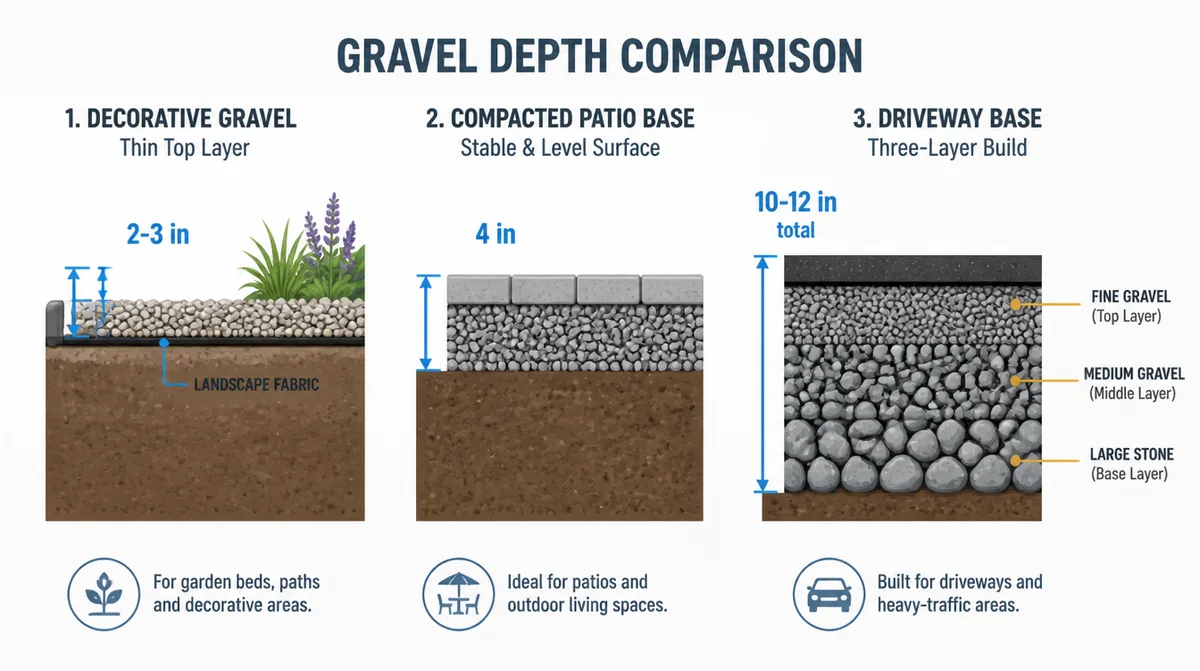
Two to 3 inches handles decorative ground cover, 4 inches handles bases and walkways that carry weight, and driveways want three compacted layers totaling 10 to 12 inches. Depth is the most expensive variable in the formula, so match it to the job:
| Project | Depth | Notes |
|---|---|---|
| Decorative beds, ground cover | 2 to 3 in | Over landscape fabric |
| Garden path | 3 in | 4 in where wheelbarrows roll |
| Patio or shed base | 4 in | Compacted before pavers or slab |
| Play area | 9 to 12 in | Impact-absorbing depth for fall safety |
| French drain | Fill trench | Clean stone only, no fines |
| Driveway (new) | 10 to 12 in total | Three layers, compacted each lift |
| Driveway (top-up) | 2 in | Every 2 to 4 years of use |
The driveway build deserves the extra detail, since it’s where most big orders go wrong. A gravel driveway that lasts is three different stones: a base layer of fist-sized #3 stone (4 inches), a middle layer of golf-ball #57 (4 inches), and a top layer of crusher run or pea-sized stone (2 to 4 inches) that locks together under traffic. Each layer gets compacted before the next goes down. Ordering one big load of a single stone size is cheaper on paper and turns into ruts and washouts by the second winter.
Compaction is the quiet volume-eater. Crusher run and other stone with fines settles 10 to 15 percent once rolled or driven on, so a 4-inch compacted layer starts life as roughly 4.5 loose inches. That’s on top of the 10 percent waste allowance, which is why driveway crews order closer to 25 percent over the raw math for base layers, then keep the extra for the first top-up.
What type of gravel should you use?
Pea gravel for looks and comfort underfoot, #57 crushed stone for drainage and bases, crusher run for anything that needs to lock solid. Here’s the master table with density, real-world coverage, and typical 2026 bulk prices in one place:
| Type | Tons per yd | 1 ton covers at 3 in | Typical 2026 price per ton | Best for |
|---|---|---|---|---|
| Pea gravel | 1.4 | 77 sq ft | $45 to $180 | Paths, seating areas, dog runs |
| Crushed stone #57 | 1.4 | 77 sq ft | $40 to $65 | Drainage, driveway middle layer, bases |
| Crusher run | 1.55 to 1.7 | 65 to 70 sq ft | $20 to $40 | Driveway top layer, compacted bases |
| River rock | 1.3 to 1.4 | 77 to 83 sq ft | $50 to $160 | Beds, borders, dry creek features |
| Decomposed granite | 1.6 | 68 sq ft | $40 to $100 | Paths, patios, xeriscape |
| Crushed granite | 1.4 to 1.5 | 72 to 77 sq ft | $25 to $50 | Driveways, modern landscaping |
Prices swing hard with region and haul distance, since stone is cheap and trucking isn’t. A quarry 10 miles away often beats a big-box store’s bulk price by half, so call two or three local suppliers before you order. Decorative stone (river rock, polished pebbles) carries the widest markups; structural stone (crusher run, #57) is the commodity end.
One material note that affects quantity: French drains and any drainage work need clean stone, meaning washed #57 or similar with no fines. Crusher run’s fine particles are exactly what makes it compact beautifully on a driveway, and exactly what clogs a drain. If your project mixes soil work with stone, the topsoil estimator handles the dirt side with the same yard math.
Should you buy bags or bulk gravel?
Bags win under half a cubic yard, bulk wins above it, and the gap gets absurd fast. A yard of gravel is 54 bags of the standard 0.5 cubic foot size. Here’s the decision table at typical 2026 prices:
| Project size | Bagged cost (0.5 cu ft bags) | Bulk cost (delivered) | Better buy |
|---|---|---|---|
| Small bed, under 0.25 yd | $55 to $110 (up to 14 bags) | Not practical | Bags |
| 0.25 to 0.5 yd | $110 to $215 | $85 to $180 with fee | Toss-up, lean bags |
| 0.5 to 1 yd | $215 to $430 | $85 to $210 with fee | Bulk |
| 1 to 5 yd | $430 to $2,150 | $150 to $600 | Bulk |
| 5+ yd (driveway) | Not practical | $35 to $80 per ton | Bulk |
The line item to watch is the delivery fee, usually $50 to $100 within a supplier’s normal radius. It makes small bulk orders look expensive, but even a 1-yard delivery at $200 beats hauling 54 bags at $300-plus, and that’s before you count the 27 trips from the car. Many suppliers also waive or shrink the fee past 3 to 5 tons, which quietly rewards ordering your whole project at once instead of layer by layer.
If you have a pickup or trailer, there’s a middle path: most quarries load half-yard and full-yard scoops directly into your bed for the bare material price. A half ton of gravel sits fine in a standard half-ton pickup; a full yard (2,800 lbs) does not, so split the trips or borrow a trailer.
Common mistakes when estimating gravel
The formula is simple, so shortages almost always come from the inputs. Four mistakes cause most of them:
Leaving depth in inches. Multiplying 10 x 10 x 3 gives 300, and 300 / 27 is 11 yards, which is a twelvefold over-order for what should be a 0.93-yard job. Inches divided by 12 first, every time.
Ignoring compaction. The 10 percent waste rule covers spillage and uneven ground, but stone with fines loses another 10 to 15 percent of its height to compaction. Base layers need both allowances, or the “4-inch” base ends up at 3 inches and change.
Ordering one stone for a layered job. A driveway is three stone sizes doing three jobs. Pricing the whole depth in cheap crusher run reads fine on the quote and fails in the field, since there’s no large-stone base carrying the load.
Skipping the fabric. Gravel on bare dirt migrates downward every wet season, and homeowners re-order a “mystery yard” every couple of years to replace it. A roll of landscape fabric costs less than the gravel it saves by the second summer.
Get the volume right, convert to tons with the right density, and buy 10 percent over (25 percent for compacted bases). Do that and the gravel part of any project is arithmetic. Punch your dimensions in, round up to the half yard, and order once.
Frequently asked questions
A single-car driveway (12x25 feet) needs about 1.9 cubic yards for a 2-inch top-up, or 11 cubic yards for a new three-layer build at 12 inches total depth. A two-car driveway (20x25 feet) roughly doubles that: 3.1 yards to refresh, 18.5 yards to build new. In tons, multiply those yard figures by 1.4 for standard crushed gravel.
One cubic yard of gravel covers 162 square feet at 2 inches deep, 108 square feet at 3 inches, 81 square feet at 4 inches, and 54 square feet at 6 inches. The math is 27 cubic feet per yard divided by the depth in feet. The 108 number is the one to memorize, since 3 inches is the most common depth for paths and decorative beds.
A cubic yard of dry gravel weighs 1.4 to 1.7 tons, and suppliers use 1.4 as the standard conversion for common crushed stone and pea gravel. Denser materials sit higher: crusher run with fines runs about 1.55 to 1.7 tons per yard, and decomposed granite about 1.6. When in doubt, ask your quarry for the density of the exact product you're ordering.
One ton of standard gravel covers about 116 square feet at 2 inches deep, 77 square feet at 3 inches, 58 square feet at 4 inches, and 39 square feet at 6 inches. That's based on 1.4 tons per cubic yard, which makes a ton roughly 0.71 yards or 19 cubic feet. Heavier products like crusher run cover slightly less per ton.
It takes 54 bags of 0.5 cubic foot gravel (the common 50 lb size) to make one cubic yard, since a yard holds 27 cubic feet. At $4 to $8 per bag, that's $215 to $430 per yard, versus $35 to $80 per ton in bulk. Bags only make sense under about half a yard; past that, bulk delivery wins even with a $50 to $100 delivery fee.
A 10x10 area (100 square feet) needs 0.62 cubic yards at 2 inches deep, 0.93 yards at 3 inches, and 1.23 yards at 4 inches. In tons, that's roughly 0.9, 1.3, and 1.7 tons of standard gravel. Order 10 percent extra to cover settling and uneven ground, so a 4-inch patio base means buying about 1.4 yards or 2 tons.
You can, but it disappears. Gravel laid on bare soil migrates down into the dirt within a season or two, especially in wet climates. Lay landscape fabric or a geotextile grid first, compact the soil, and the same load of gravel lasts years longer. For driveways, a compacted base layer of larger stone under the surface gravel is what keeps ruts from forming.
Calcowa's editorial team builds and checks every calculator against published formulas, then writes these guides so the numbers make sense. Each tool shows its formula and a worked example. See our methodology.
Related guides
How Many Tiles Do I Need? (with Waste Factor)
How many tiles do I need? A 10x10 room takes 110 twelve-inch tiles with waste included. Get the formula, waste factors by layout, and box counts by size.
ConstructionHow Much Concrete Do I Need? Formula and Chart
How much concrete do I need? A 10x10 slab at 4 inches takes 1.23 cubic yards, about 56 bags of 80 lb mix. Get the formula, yardage charts, and bag counts.
ConstructionHow Much Paint Do I Need for a Room?
How much paint do I need? Most rooms take 2 gallons for two coats of wall paint. Get the formula, gallons-by-room-size charts, and ceiling and trim math.