
How Much Concrete Do I Need? Formula and Chart
How much concrete do I need? A 10x10 slab at 4 inches takes 1.23 cubic yards, about 56 bags of 80 lb mix. Get the formula, yardage charts, and bag counts.
Short answer: how much concrete do I need for a typical slab? A 10x10 pad poured 4 inches thick takes 1.23 cubic yards, which is 56 bags of 80 lb mix. Most patios land between 1 and 3 cubic yards, and most driveways between 5 and 10. The exact number comes from one formula: length x width x thickness, divided by 27. Below you’ll find that math worked out, yardage charts for the most common slab sizes, bag counts for every bag size sold, and the bags-versus-truck cost math that decides how you should buy it.
Want to skip the arithmetic? The concrete estimator takes your slab dimensions and returns cubic yards, bags, and a waste allowance in seconds.
How much concrete do I need for a slab?
Here’s the lookup chart before the formula. It covers the eight most common US pour sizes at both standard thicknesses, with bag counts rounded up to whole bags. Figures are raw volume; add 10 percent when you buy, for spillage and low spots in the base.
| Slab size | 4 in: cubic yards | 4 in: 80 lb bags | 6 in: cubic yards | 6 in: 80 lb bags |
|---|---|---|---|---|
| 6x6 ft (pad) | 0.44 | 20 | 0.67 | 30 |
| 8x8 ft (shed) | 0.79 | 36 | 1.19 | 54 |
| 10x10 ft (patio) | 1.23 | 56 | 1.85 | 84 |
| 12x12 ft (patio) | 1.78 | 80 | 2.67 | 120 |
| 10x20 ft (parking strip) | 2.47 | 112 | 3.70 | 167 |
| 16x16 ft (large patio) | 3.16 | 143 | 4.74 | 214 |
| 20x20 ft (2-car garage) | 4.94 | 223 | 7.41 | 334 |
| 24x24 ft (garage) | 7.11 | 320 | 10.67 | 480 |
Two things jump out of that table. First, thickness matters as much as footprint: going from 4 to 6 inches adds 50 percent to every number. Second, bag counts get silly fast. Nobody should hand-mix 223 bags for a garage floor, and the truck-versus-bags section below shows where the crossover sits.
How do you calculate concrete in cubic yards?
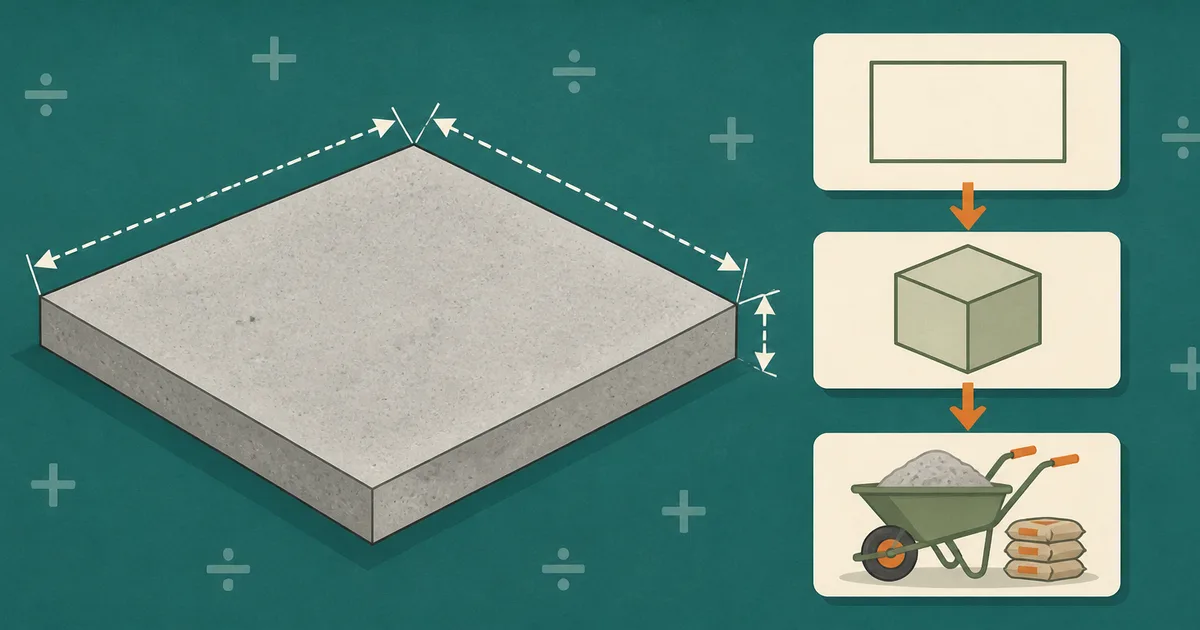
Multiply length by width by thickness to get cubic feet, then divide by 27 to get cubic yards. The only trap is units: thickness must be in feet, so divide the inches by 12 first. Here’s the full method on a 10x10 patio at 4 inches:
Step 1: convert thickness to feet. 4 inches / 12 = 0.333 feet.
Step 2: multiply the three dimensions. 10 x 10 x 0.333 = 33.3 cubic feet. For an odd footprint, split it into rectangles, or let the square footage tool total the area for you first.
Step 3: divide by 27. A cubic yard is 27 cubic feet, so 33.3 / 27 = 1.23 cubic yards.
Step 4: add 10 percent waste. 1.23 x 1.1 = 1.36 cubic yards. Order 1.5 and you’re covered.
There’s a shortcut worth memorizing for 4-inch slabs: divide the square footage by 81, because one cubic yard spread 4 inches thick covers exactly 81 square feet. A 400 square foot driveway? 400 / 81 = 4.94 yards. It’s the same math as the four steps above, compressed into one division.
Concrete suppliers sell in quarter-yard increments, and they’d rather you round up. Coming up half a yard short mid-pour means a cold joint, a second delivery fee, and a visible seam that never goes away. The extra quarter yard costs about $40; the shortage costs the finish.
How many bags of concrete do you need?
Divide your cubic feet by the yield printed on the bag: an 80 lb bag yields 0.60 cubic feet, a 60 lb bag 0.45, and a 40 lb bag 0.30. That’s the whole method, and the table below does it for every size sold, using the 10x10x4 slab (33.3 cubic feet) as the example.
| Bag size | Yield per bag | Bags per cubic yard | Bags for a 10x10x4 slab |
|---|---|---|---|
| 40 lb | 0.30 cu ft | 90 | 112 |
| 50 lb | 0.375 cu ft | 72 | 89 |
| 60 lb | 0.45 cu ft | 60 | 75 |
| 80 lb | 0.60 cu ft | 45 | 56 |
| 90 lb | 0.675 cu ft | 40 | 50 |
Bigger bags cost less per cubic foot, so buy the largest size you can lift comfortably, mix after mix. An 80 lb bag straight off a truck bed feels fine; the fortieth one at hour three doesn’t. Crews mixing solo often land on 60 lb bags as the sweet spot between price and back strain.
One pallet of 80 lb bags usually holds 42 bags, which is just shy of a cubic yard. If your project needs more than a pallet, that’s the signal to price ready-mix before you commit to mixing.
Should you buy bags or order ready-mix?
Bags make sense under half a cubic yard, and a ready-mix truck wins above one yard, even after delivery fees. Between those marks, it comes down to how much your Saturday is worth. Here’s the decision table at typical 2026 prices:
| Project size | Bagged cost (80 lb) | Ready-mix cost | Better buy |
|---|---|---|---|
| Post holes, repairs (under 0.25 yd) | $40 to $80 | Not practical | Bags |
| Small pad, 0.25 to 0.5 yd | $75 to $160 | $210 to $325 with fee | Bags |
| 0.5 to 1 yd | $150 to $360 | $210 to $325 with fee | Toss-up, lean truck |
| 1 to 4 yd | $300 to $1,400 | $285 to $850 with fee | Ready-mix |
| 4+ yd (driveway, garage) | Not practical | $135 to $175 per yd | Ready-mix |
The line item most guides never mention is the short-load fee. Ready-mix trucks hold 8 to 10 yards, and dispatchers charge $75 to $150 extra on orders below their minimum, usually 4 or 5 yards. That fee is why a 1-yard delivery costs $210 to $325 instead of $150. It still beats hand-mixing 45 bags, which takes two people the better part of a day and risks weak spots wherever a batch got too wet.
There’s a middle path for the 1-to-2-yard zone: renting a towable mixer for $60 to $90 a day turns bag work from brutal to merely tiring, and U-cart trailers (you tow a yard of wet mix home) run $130 to $180 where they’re available.
If you do order a truck, the dispatcher needs three numbers beyond the yardage. First, the strength: ask for 3,000 PSI mix for patios and walkways, 3,500 to 4,000 PSI for driveways and garage floors. Second, the slump, which is how wet the mix arrives; 4 to 5 inches is the workable standard for flatwork. Third, access: how close the truck can park, since chutes only reach 15 to 18 feet and every wheelbarrow trip past that adds time you’re paying standby charges for. Plants bill waiting time after the first 30 to 60 minutes on site, so have your forms, tools, and helpers ready before the truck rolls in.
How thick should a concrete slab be?
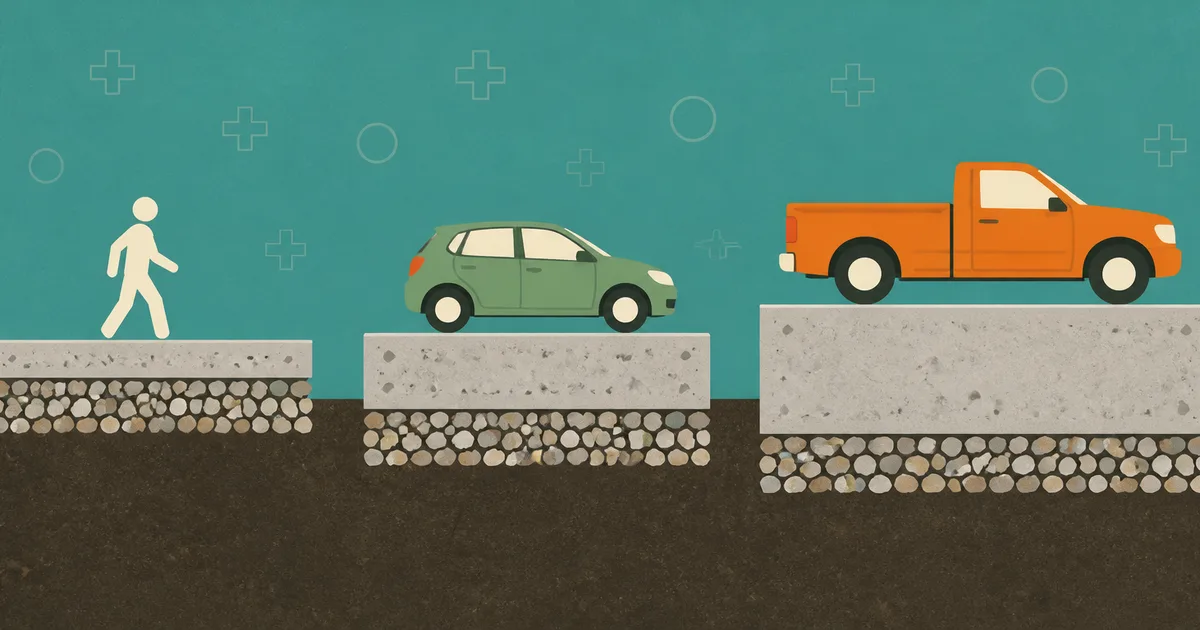
Four inches handles foot traffic, 5 inches handles cars, and 6 inches handles trucks. Thickness is the most expensive variable in the formula, so match it to the load instead of defaulting to thick:
| Project | Thickness | Notes |
|---|---|---|
| Walkway, sidewalk | 4 in | 3.5 in works over a compacted base |
| Patio | 4 in | Go 5 in under a hot tub or heavy pergola posts |
| Shed slab | 4 to 6 in | Match to what you’ll park inside |
| Driveway (cars) | 5 in | Wire mesh or fiber mix recommended |
| Driveway (trucks, RV) | 6 in | Rebar grid, not just mesh |
| Garage floor | 6 in | Thickened edges where posts land |
| Footings | 8 to 12 in | Code and frost line govern, check locally |
A pro trick for budgeting: price your pour at a quarter inch thicker than planned. Subgrades are never perfectly level, and the low spots eat concrete. On a 10x10 slab that quarter inch is about 2 cubic feet, or three or four extra bags, which is exactly the margin that keeps you from a second store run with wet concrete setting behind you.
Every slab also wants what’s under and inside it accounted for: a 4-inch compacted gravel base (the gravel estimator sizes that in yards and tons) and reinforcement sized to the span (the rebar layout tool turns slab dimensions into bar counts and spacing).
What does concrete cost in 2026?
Budget $135 to $175 per cubic yard for ready-mix delivered, $6 to $8 per 80 lb bag, and $6 to $12 per square foot for a finished slab with labor. Here’s the full picture:
| Item | Typical 2026 price | Notes |
|---|---|---|
| Ready-mix, per cubic yard | $135 to $175 | 3,000 to 4,000 PSI mix, delivered |
| Short-load fee | $75 to $150 | Orders under 4 to 5 yards |
| 80 lb bag, standard mix | $6 to $8 | About $270 to $360 per yard equivalent |
| 80 lb bag, high-strength or fast-set | $8 to $12 | Sets in 20 to 40 minutes |
| Concrete pump rental | $150 to $200 per hour | Only when the truck can’t reach |
| Finished slab, installed | $6 to $12 per sq ft | Includes labor, forms, mesh, finishing |
Prices swing with region and season. Demand peaks from April through September, and some plants quote 10 to 15 percent higher in those months. If your pour can wait for shoulder season, the same yard of mud costs less in October than in June.
For a sanity check on the totals: that 20x20 garage slab at 6 inches is 7.4 yards of ready-mix, so $1,000 to $1,300 in concrete before labor. The bagged equivalent would be 334 bags at roughly $2,300, which is why nobody bags a garage floor.
What about post holes and round columns?
Round forms use a different formula: 3.14 x radius squared x depth, all in feet. In practice you just need bags per foot of depth, so here’s the chart for the common tube and post sizes:
| Form diameter | Volume per ft of depth | 80 lb bags per ft | Typical use |
|---|---|---|---|
| 8 in tube | 0.35 cu ft | 0.6 | Deck footings |
| 10 in tube | 0.55 cu ft | 0.9 | Deck and porch posts |
| 12 in tube | 0.79 cu ft | 1.3 | Pergolas, heavy decks |
| Fence post hole (8 in, post in place) | ~0.25 cu ft | ~0.4 | 4x4 fence posts |
A standard 4x4 fence post set 2 feet deep in an 8-inch hole takes just under one 80 lb bag once the post displaces its share. That’s why fence crews figure one 80 lb bag per post and come out about right across a whole run. For deck footings below frost line (3 to 4 feet in cold states), a 10-inch tube eats 3 to 4 bags each, and a 10-post deck suddenly needs 35 bags. Run your own sizes through the footing volume tool before the store trip, since it handles tubes and square footings alongside slabs.
Common mistakes when estimating concrete
The formula is simple, so nearly every shortage comes from the inputs. These four mistakes cause most of them:
Measuring thickness in inches without converting. Multiplying 10 x 10 x 4 gives 400, and 400 / 27 is nearly 15 yards, which is a twelvefold over-order. It happens more than you’d think. Inches divided by 12 first, always.
Trusting the subgrade to be flat. A base that dips half an inch across a 200 square foot pour swallows a third of a yard. That’s the whole reason for the 10 percent waste rule, and it’s why pros probe the base depth in several spots before ordering.
Forgetting the concrete isn’t the whole job. Gravel base, forms, mesh or rebar, and expansion joints all belong on the same shopping list. Estimating one material at a time is how projects stall mid-weekend. The measure-once habit pays off on every trade that follows, right down to how much paint the finished garage walls need.
Mixing bags too wet. Extra water makes bags easier to mix and noticeably weaker. If a batch pours like soup, it’ll cure well below its rated strength, and a slab mixed inconsistently across 50 bags develops soft spots. Follow the water line on the bag, not your arms’ preference.
Get the volume right, buy 10 percent over, and match bags versus truck to the size of the pour. Do those three things and the concrete part of any slab project turns into arithmetic. Punch your dimensions in, round up to the quarter yard, and pour once.
Frequently asked questions
A 10x10 slab poured 4 inches thick holds 33.3 cubic feet of concrete, which is 56 bags of 80 lb mix or 75 bags of 60 lb mix. At 6 inches thick, the same slab needs 84 bags of 80 lb mix. Add 10 percent for spillage and an uneven base, so buy 62 and 92 bags respectively. At that quantity, ready-mix delivery is usually the smarter buy.
One cubic yard of concrete covers 81 square feet at 4 inches thick, 54 square feet at 6 inches, and 108 square feet at 3 inches. The math is simple: a yard is 27 cubic feet, so divide 27 by the thickness in feet. That 81 number is worth memorizing, since dividing any 4-inch slab's square footage by 81 gives you cubic yards instantly.
It takes 45 bags of 80 lb concrete mix to make one cubic yard, since each bag yields about 0.60 cubic feet and a yard holds 27 cubic feet. For the smaller sizes, figure 60 bags of 60 lb mix, 72 bags of 50 lb mix, or 90 bags of 40 lb mix per yard. A full pallet of 80 lb bags (usually 42) comes in just under one yard.
Bags win under about half a cubic yard, and ready-mix wins above one yard. At 2026 prices, a yard of bagged 80 lb mix costs $270 to $360 in materials alone, plus hours of mixing. Ready-mix runs $135 to $175 per yard delivered, though orders under 4 or 5 yards usually pay a short-load fee of $75 to $150. Even with that fee, one yard delivered often costs less than mixing 45 bags yourself.
Pour 4 inches for patios, walkways, and shed slabs, 5 inches for a driveway that carries cars, and 6 inches for garage floors or anywhere trucks park. Footings are a different animal: most residential codes call for 8 to 12 inches deep, sized to your local frost line, so check with your building department before you dig.
Ready-mix concrete costs $135 to $175 per cubic yard delivered in most US markets in 2026, with high-cost metros pushing $200. Orders below the truck minimum (typically 4 to 5 yards) add a short-load fee of $75 to $150. A finished slab with labor, forms, and reinforcement included runs $6 to $12 per square foot installed.
Split the shape into rectangles, circles, and triangles, figure each one's volume, then add them up. An L-shaped patio is just two rectangles. For circles, multiply 3.14 by the radius squared, then by the depth. Measure twice, since a half-inch depth error across a big pour swings the total by a full bag or more per 100 square feet.
Calcowa's editorial team builds and checks every calculator against published formulas, then writes these guides so the numbers make sense. Each tool shows its formula and a worked example. See our methodology.
Related guides
How Much Gravel Do I Need? Coverage Chart
How much gravel do I need? A 10x10 patio base at 4 inches takes 1.23 cubic yards, about 1.7 tons. Get the formula, coverage charts, and ton conversions.
ConstructionHow Many Tiles Do I Need? (with Waste Factor)
How many tiles do I need? A 10x10 room takes 110 twelve-inch tiles with waste included. Get the formula, waste factors by layout, and box counts by size.
ConstructionHow Much Paint Do I Need for a Room?
How much paint do I need? Most rooms take 2 gallons for two coats of wall paint. Get the formula, gallons-by-room-size charts, and ceiling and trim math.