
How Many mL in a Cup? US, UK and Metric
How many mL in a cup? A US cup is 237 mL, a metric cup is 250 mL, and a UK cup holds 284 mL. Get the full chart, cup-size decoder, and rounding error math.
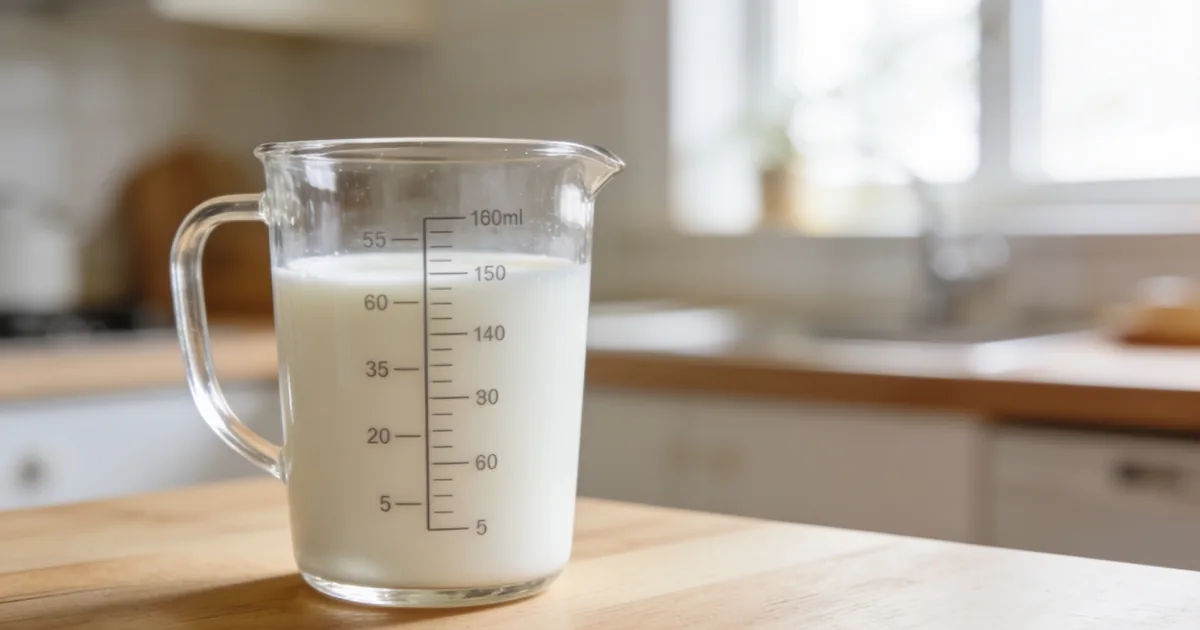
Short answer: how many mL in a cup? A US cup holds 236.588 mL, which rounds to 237 mL. That’s the number behind almost every American recipe. But it’s not the only cup out there: nutrition labels use a 240 mL cup, Australian and Canadian recipes use a 250 mL metric cup, and old British cookbooks mean 284 mL. Grab the wrong one and every scoop in the recipe drifts.
This guide gives you the full mL chart for every cup fraction, a decoder that tells you which cup your recipe actually means based on where it was written, the rounding-error math nobody shows, and the odd cups hiding in your kitchen, like the 180 mL one that came with your rice cooker.
If you just need a number converted right now, the mL to cups converter handles any amount instantly, and the cups to mL converter works the other direction.
How many mL in a cup exactly?
One US cup equals 236.588 mL. That comes from the definition chain: a US cup is 8 US fluid ounces, and each fluid ounce is 29.5735 mL. In practice everyone rounds to 237 mL, and plenty of measuring cups just print 240 to match nutrition labels.
Here’s every cup fraction in milliliters, using the US customary cup:
| Cups (US) | Milliliters | Also equals |
|---|---|---|
| 2 cups | 473 mL | 1 US pint |
| 1 cup | 237 mL | 8 fl oz / 16 tbsp |
| 3/4 cup | 177 mL | 12 tbsp |
| 2/3 cup | 158 mL | 10 tbsp + 2 tsp |
| 1/2 cup | 118 mL | 8 tbsp |
| 1/3 cup | 79 mL | 5 tbsp + 1 tsp |
| 1/4 cup | 59 mL | 4 tbsp |
| 1/8 cup | 30 mL | 2 tbsp |
| 1/16 cup | 15 mL | 1 tbsp |
Three anchors are worth memorizing. A full cup is 237 mL. Half a cup is 118 mL, the fraction recipes reach for most. And a quarter cup is 59 mL, which you can sanity-check against the 60 mL line printed on most liquid measuring jugs.
The chart holds for liquids and dry ingredients alike, because cups and milliliters both measure volume. What changes with dry ingredients is weight: 237 mL of flour weighs about 120 grams while 237 mL of sugar weighs 200 grams. When a recipe lists grams instead, the cups to grams converter does that translation per ingredient.
Which cup size is your recipe actually using?
Here’s the part most conversion charts skip: “cup” isn’t one unit. Five different cups are in active use around the world, and the recipe’s origin tells you which one its author meant. This decoder routes you to the right number:
| Where the recipe comes from | Cup it means | mL |
|---|---|---|
| US cookbook, blog, or magazine | US customary cup | 237 mL |
| US nutrition facts label | US legal cup | 240 mL |
| Australia, NZ, modern Canada | Metric cup | 250 mL |
| Older Canadian cookbook | Canadian cup | 227 mL |
| Older UK cookbook | Imperial cup | 284 mL |
| Japanese recipe | Japanese cup | 200 mL |
| Rice cooker manual | Go cup | 180 mL |
The spread is bigger than people expect. A British imperial cup holds 20% more than an American one, and a Japanese cup holds 16% less. Bake an old UK scone recipe with US cups and every ingredient comes in light; bake an American cookie recipe with an Australian 250 mL cup and everything runs heavy.
A few routing tips when the origin isn’t obvious. Spelling gives away UK and Australian recipes (colour, flavour, caster sugar). Ingredient names help too: an Australian recipe says “plain flour” where an American one says “all-purpose.” And any recipe that lists both cups and grams lets you check: if 1 cup of flour is listed near 150 grams, that’s a 250 mL metric cup, while American recipes put a cup of flour at 120 to 125 grams.
Modern British recipes mostly sidestep the problem by giving weights in grams and liquids in mL directly, which is why UK measuring jugs rarely show cup lines at all.
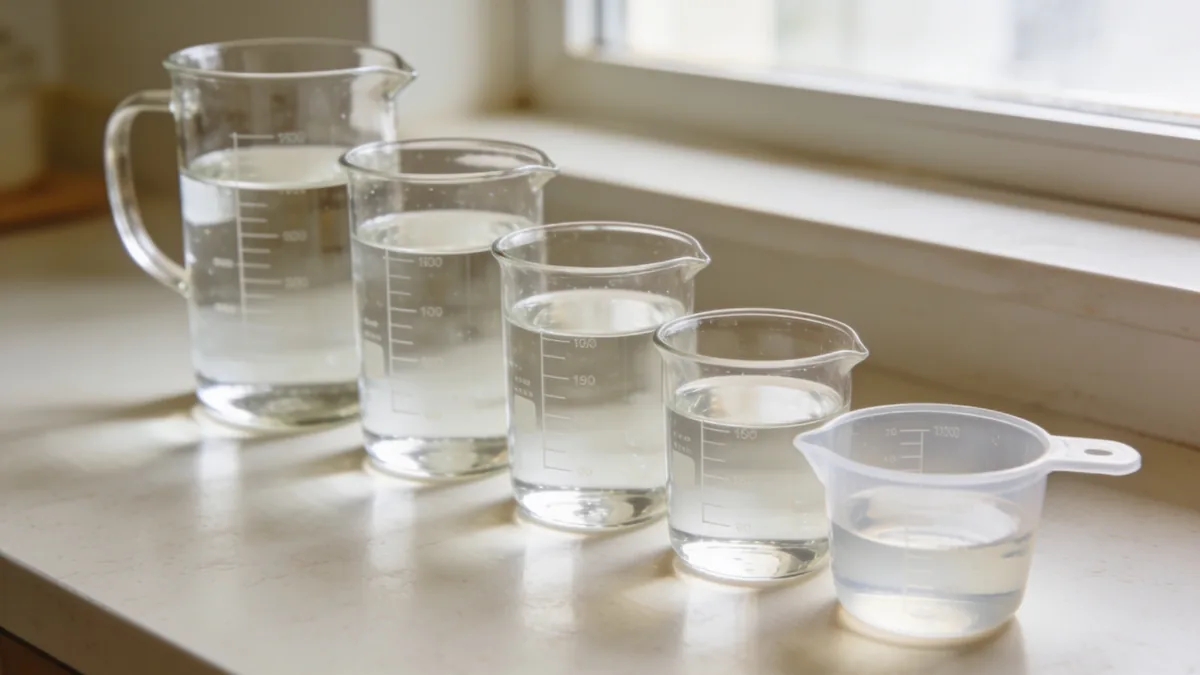
How many cups is 250 mL, 100 mL, or 500 mL?
Going from milliliters back to cups is the direction bottled and packaged ingredients force on you, since cartons and cans list mL. Divide by 236.588 for US cups, or use this chart for the amounts that come up constantly:
| Milliliters | US cups | Practical measure |
|---|---|---|
| 50 mL | 0.21 cup | 3 tbsp + 1 tsp |
| 100 mL | 0.42 cup | 6 tbsp + 2 tsp |
| 125 mL | 0.53 cup | 1/2 cup + 1.5 tsp |
| 150 mL | 0.63 cup | 2/3 cup, scant |
| 200 mL | 0.85 cup | 3/4 cup + 4 tsp |
| 250 mL | 1.06 cups | 1 cup + 1 tbsp |
| 300 mL | 1.27 cups | 1 1/4 cups + 1 tsp |
| 375 mL | 1.59 cups | 1 1/2 cups + 4 tsp |
| 500 mL | 2.11 cups | 2 cups + 2 tbsp |
| 750 mL | 3.17 cups | 3 cups + 3 tbsp |
| 1000 mL (1 L) | 4.23 cups | 4 1/4 cups, scant |
The one to burn into memory is 250 mL = 1.06 US cups, or a cup plus a tablespoon. It settles the most common metric-recipe question in one line: when an Australian recipe says 1 cup, add a tablespoon to your US cup and you’ve matched it.
For cooking, the “practical measure” column is usually close enough. For anything precise, like diluting a concentrate or mixing a brine, punch the exact number into the mL to cups converter instead of stacking spoon approximations. And if your jug shows fluid ounces rather than mL, the mL to oz converter bridges that gap.
Is a cup 237 mL or 240 mL?
Both numbers are correct, because the United States defines two cups. The customary cup, the one your measuring cup is built around, is 236.588 mL. The legal cup, which the FDA defines for nutrition labeling, is exactly 240 mL. Regulators picked a round number so serving-size math on packages stays clean.
| Cup definition | Exact mL | Used for |
|---|---|---|
| US customary cup | 236.588 mL | Recipes, kitchen measuring cups |
| US legal cup | 240 mL | Nutrition facts labels, FDA serving sizes |
| Metric cup | 250 mL | AU/NZ/Canadian recipes |
| UK imperial cup | 284.131 mL | Pre-metric British cookbooks |
The customary-vs-legal gap is 3.4 mL, about 1.4%, and you can ignore it everywhere. No recipe fails and no calorie count moves meaningfully over a teaspoon’s worth of difference. It only matters if you’re wondering why your measuring cup, a soda label, and a conversion site give three slightly different numbers. They’re not wrong; they’re answering with different cups.
The number that does deserve attention is the metric cup’s 250 mL, because it’s off by enough to change results. That’s the next section.
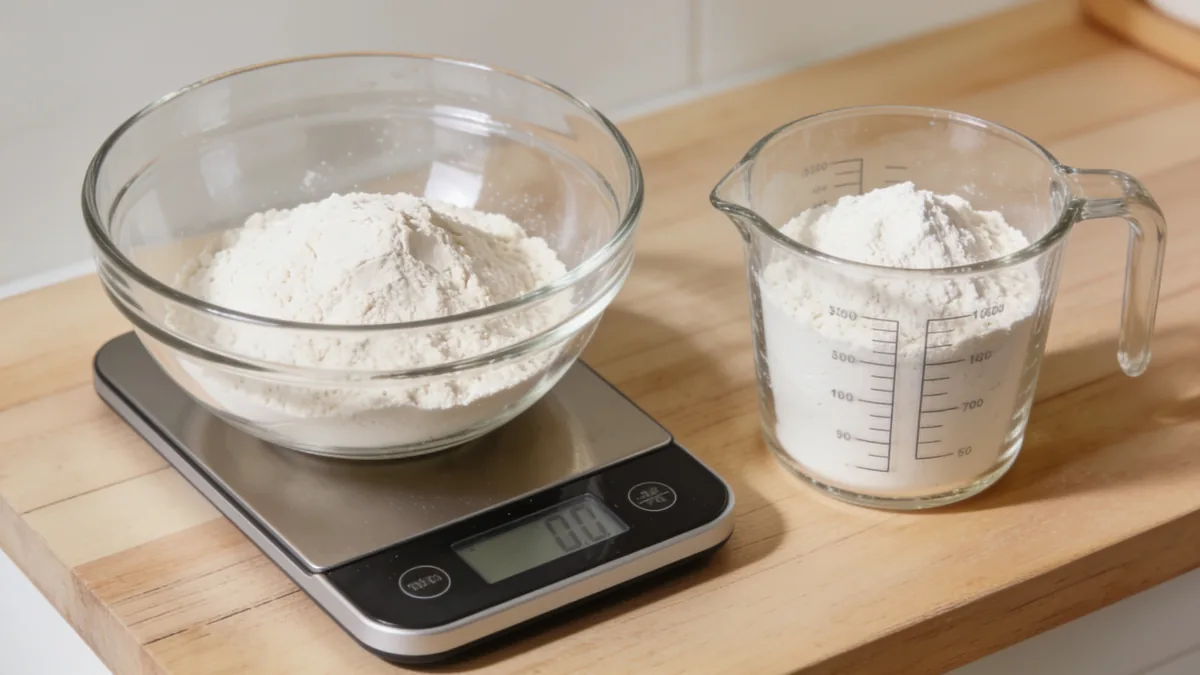
Does using a 250 mL cup ruin a US recipe?
Sometimes, and the failure is predictable. A 250 mL metric cup holds 13.4 mL more than a US cup, an overshoot of 5.7% on every scoop. One extra scoop’s error is a rounding blip. Multiply it across a real recipe and it stops being one:
| Ingredient in a US recipe | Measured with 250 mL cup | Extra added | Does it matter? |
|---|---|---|---|
| 1 cup milk in pancakes | +13 mL | ~1 tbsp | No, batter forgives it |
| 2 cups broth in soup | +27 mL | ~2 tbsp | No, season to taste |
| 2 cups flour in cookies | +27 mL (~14 g) | 5.7% more flour | Borderline, slightly dry |
| 4 cups flour in bread | +54 mL (~27 g) | 5.7% more flour | Yes, stiffer dough |
| 1 cup butter in cake | +13 mL (~12 g) | 5.7% more fat | Yes, texture shifts |
The pattern: cooking absorbs the error, baking accumulates it. Soups, sauces, and marinades get adjusted by taste anyway. Baking is chemistry by ratio, and a 5.7% skew applied to flour, sugar, and fat at once tilts the whole formula in the same direction. That’s how an American cookie recipe made in an Australian kitchen turns out thick and cakey.
Two clean fixes. If the recipe gives weights, use the scale and the cup question disappears entirely. If it doesn’t, short each metric cup by 1 tablespoon when making US recipes, which lands you within half a percent. The same trick in reverse, adding a tablespoon, converts your US cups for Australian recipes.
Going the other way, UK imperial cups are off by so much (20%) that no spoon trick rescues them. Convert those recipes to mL on paper first.
Why is a rice cooker cup only 180 mL?
The plastic cup that ships with every rice cooker holds 180 mL, and it’s not a manufacturing shortcut. It’s the Japanese go, a traditional unit for rice that predates the metric system, and the industry standardized on it worldwide. Your cooker’s inner-pot water lines assume you measured rice with that 180 mL cup, so swapping in a US cup quietly adds 30% more rice than line 1 expects, which is how rice ends up crunchy.
Rice cookers aren’t the only place a “cup” shrinks. Here are the non-standard cups hiding around your kitchen:
| The “cup” | Actual volume | Where you meet it |
|---|---|---|
| Rice cooker cup (go) | 180 mL | Rice cooker measuring cup and pot lines |
| Coffee maker cup | 150 mL | The “12-cup” carafe (it brews 1.8 L, not 2.8 L) |
| Japanese recipe cup | 200 mL | Japanese cookbooks and sauce bottles |
| Teacup (informal) | 150 to 200 mL | Older recipes that say “a teacup of…” |
| US customary cup | 237 mL | The actual measuring cup |
The coffee maker one explains a common kitchen puzzle: a “12-cup” machine fills about 7.5 real cups. Manufacturers inherited a 5 to 6 ounce serving from traditional coffee culture and never updated the label. So when a hydration tracker asks for cups of water, don’t count carafe cups; a US cup of water is 237 mL and weighs 237 grams, which is what makes metric hydration math so tidy.
The lesson across all of these: a cup is only 237 mL when it’s an actual US measuring cup. Branded scoops, carafes, and bundled cups each have their own agenda.
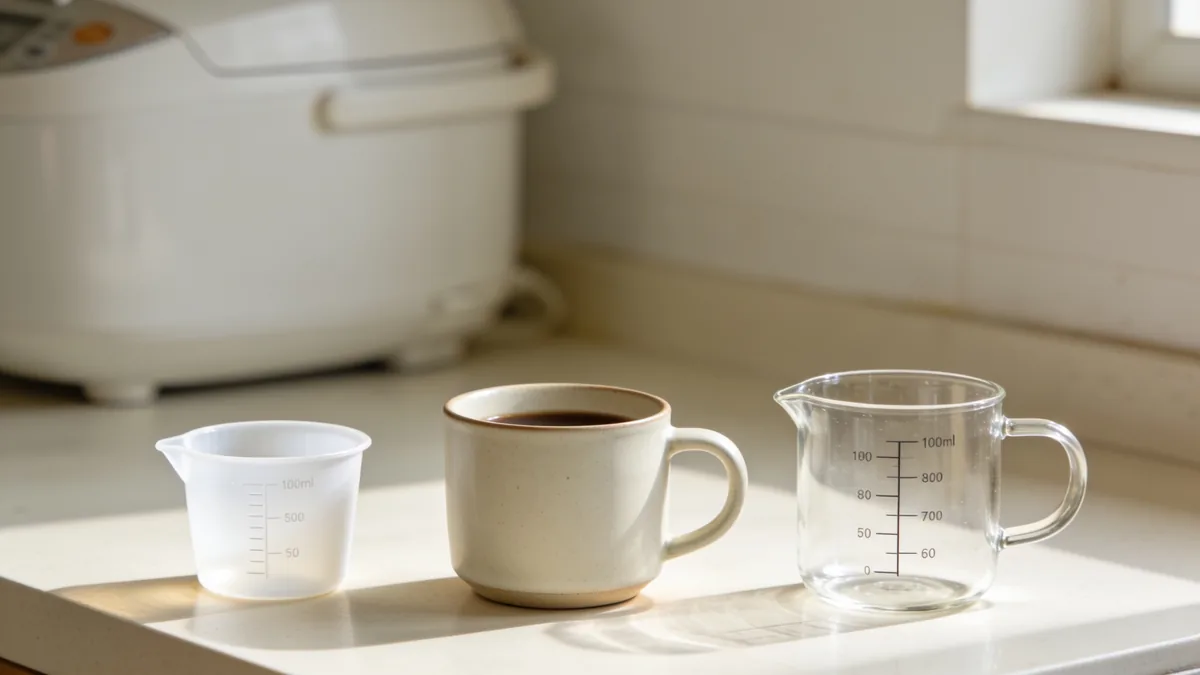
How do you measure mL without a measuring jug?
Measuring spoons are secretly metric instruments. A US teaspoon is 4.93 mL and a tablespoon is 14.79 mL, close enough to 5 and 15 that the rounding never hurts. That turns any mL amount into spoon counts:
| You need | Spoon measure | Exact mL delivered |
|---|---|---|
| 5 mL | 1 tsp | 4.9 mL |
| 10 mL | 2 tsp | 9.9 mL |
| 15 mL | 1 tbsp | 14.8 mL |
| 30 mL | 2 tbsp | 29.6 mL |
| 45 mL | 3 tbsp | 44.4 mL |
| 60 mL | 4 tbsp (1/4 cup) | 59.1 mL |
| 75 mL | 5 tbsp | 74 mL |
| 90 mL | 6 tbsp | 88.7 mL |
Past 90 mL or so, counting spoons invites errors, so switch to cup fractions and combine: 150 mL is a half cup plus 2 tablespoons, and 200 mL is three quarters of a cup plus 4 teaspoons. The tsp to mL converter handles odd spoon amounts, and the full spoon-to-cup system is mapped in our tablespoons in a cup guide.
One caution that mirrors the cup problem: Australian tablespoons are 20 mL, not 15. An Australian recipe’s “2 tablespoons” means 40 mL, which is nearly 3 US tablespoons. Same trap, smaller spoon.
There’s also the scale trick, which beats spoons for water-like liquids. Since 1 mL of water weighs 1 gram, you can weigh 150 grams of water, milk, broth, or juice and call it 150 mL. It’s accurate to within a couple percent for anything thin, though it fails for oils (0.92 g/mL) and honey (1.4 g/mL).
For the fluid-ounce side of the same problem, where a jug shows oz lines but the recipe says mL, our ounces in a cup guide covers that whole system, including why dry ounces don’t play by these rules.
So the next time a recipe hands you cups and your ingredients arrive in milliliters, you’ve got the full toolkit: 237 mL per US cup, a decoder for every other cup, and spoon math for everything in between. Run any exact amount through the cups to mL converter and get back to cooking.
Frequently asked questions
A US cup holds 236.588 mL, which everyone rounds to 237 mL. If you're reading a nutrition label, that cup is 240 mL. An Australian, New Zealand, or modern Canadian recipe means a 250 mL metric cup, and an old British cookbook means a 284 mL imperial cup. The right answer depends on where the recipe was written.
Half a US cup is 118 mL, half a metric cup is 125 mL, and half a UK imperial cup is 142 mL. For most cooking, the 118 vs 125 difference won't matter, but in baking it can. If the recipe is American, measure 118 mL; if it's Australian or uses metric cups, go with 125 mL.
Only in metric-cup countries. Australia, New Zealand, and modern Canadian recipes define a cup as exactly 250 mL. A US cup is 236.588 mL, so 250 mL equals about 1.06 US cups. Filling a US recipe's cup with 250 mL adds 5.7% extra to every scoop, which stacks up fast in multi-cup baking.
100 mL is 0.42 US cups, which is just under half a cup. In practical kitchen terms, it's 6 tablespoons plus 2 teaspoons, or a little less than 7 tablespoons. If your measuring cup only shows cup fractions, fill to a hair below the 1/2 cup line and you'll land close enough for cooking.
A US cup of water is 237 mL, and it weighs almost exactly 237 grams, since water's density is 1 gram per mL. That's why hydration math is easy in metric: the common advice of 8 cups a day works out to about 1.9 liters. A metric cup of water is 250 mL and 250 grams.
US food labels use the FDA's legal cup, defined as exactly 240 mL to make label math cleaner. Your kitchen measuring cup holds the customary 236.588 mL. The gap is only 3.4 mL, about 1.4%, so a labeled serving and a measured cup are close enough that you'll never taste or track the difference.
The cup that ships with a rice cooker is 180 mL, not 237 or 250. It's the Japanese go, a traditional rice unit the industry kept. Your cooker's water lines are calibrated to that 180 mL cup, so always measure rice with the included cup. Using a US cup adds about 30% more rice than the markings expect.
Calcowa's editorial team builds and checks every calculator against published formulas, then writes these guides so the numbers make sense. Each tool shows its formula and a worked example. See our methodology.
Related guides
How Many Tablespoons in a Cup? Full Chart
How many tablespoons in a cup? A US cup holds 16 tablespoons or 48 teaspoons. Get every fraction chart, butter stick math, and the awkward thirds workaround.
ConvertersHow Many Ounces in a Cup? Dry vs Liquid
How many ounces in a cup? A US cup is 8 fluid ounces, but dry ounces vary: a cup of flour weighs 4.2 oz, sugar 7.1 oz. Get the full charts and the fix.
ConvertersBaking Substitutes: Eggs, Butter, Dairy, Oil
Baking substitutes for eggs, butter, buttermilk, sour cream, heavy cream, milk, and oil, with exact ratios, gram weights, and a swap risk rating for each.