
Study Tips That Actually Work (Science-Backed)
Study tips ranked by evidence: which techniques top the research, which waste your hours, plus the weekly study-hour math nobody shows you. Charts inside.
Short answer: the study tips that actually work are practice testing and spaced repetition, and the ones you probably rely on, rereading and highlighting, rank dead last in the research. That’s not an opinion. It’s the conclusion of the largest review of study techniques ever published, and this guide turns it into tables you can act on: an evidence ranking, a spacing schedule, and the weekly study-hour math that competitor listicles skip.
Working toward a target grade? Check where your semester stands in a few seconds, then use what’s below to close the gap.
Which study tips actually work? The evidence ranking
Psychologist John Dunlosky and four colleagues reviewed decades of experiments on ten popular study techniques for the journal Psychological Science in the Public Interest in 2013. Only two earned their top rating. Most of what students do by default landed at the bottom.
| Technique | What it means | Evidence rating |
|---|---|---|
| Practice testing | Quizzing yourself from memory | High |
| Spaced practice | Spreading sessions over days | High |
| Interleaving | Mixing problem types in one session | Moderate |
| Elaborative interrogation | Asking “why is this true?” | Moderate |
| Self-explanation | Talking through each step | Moderate |
| Summarization | Rewriting content in your own words | Low |
| Highlighting | Marking key lines | Low |
| Keyword mnemonics | Linking terms to imagery | Low |
| Imagery for text | Visualizing while reading | Low |
| Rereading | Going through the chapter again | Low |
The pattern is blunt: techniques that force your brain to produce information work, and techniques that let you passively recognize it don’t. Every section below builds on that one idea.
Why don’t rereading and highlighting work?
They create familiarity, and familiarity feels like knowledge. When you reread a chapter, the words look recognizable on pass two, so your brain files the material as learned. Researchers call it the fluency illusion, and it’s the main reason students walk out of exams stunned by their score.
| Habit | Why it feels productive | What the research says |
|---|---|---|
| Rereading | The text feels familiar | Little benefit after the first pass |
| Highlighting | You’re actively marking | No measurable gain over plain reading |
| Recopying notes | Pages of output | Transcribing isn’t retrieval |
| Cramming | High effort, visible sacrifice | Retention collapses within days |
None of these are evil. Highlighting can flag what to make flashcards from, and one reread makes sense when the material never landed the first time. The problem starts when they’re the whole plan, because you’re spending real hours on the four weakest tools on the shelf.
What is active recall and how do you use it?
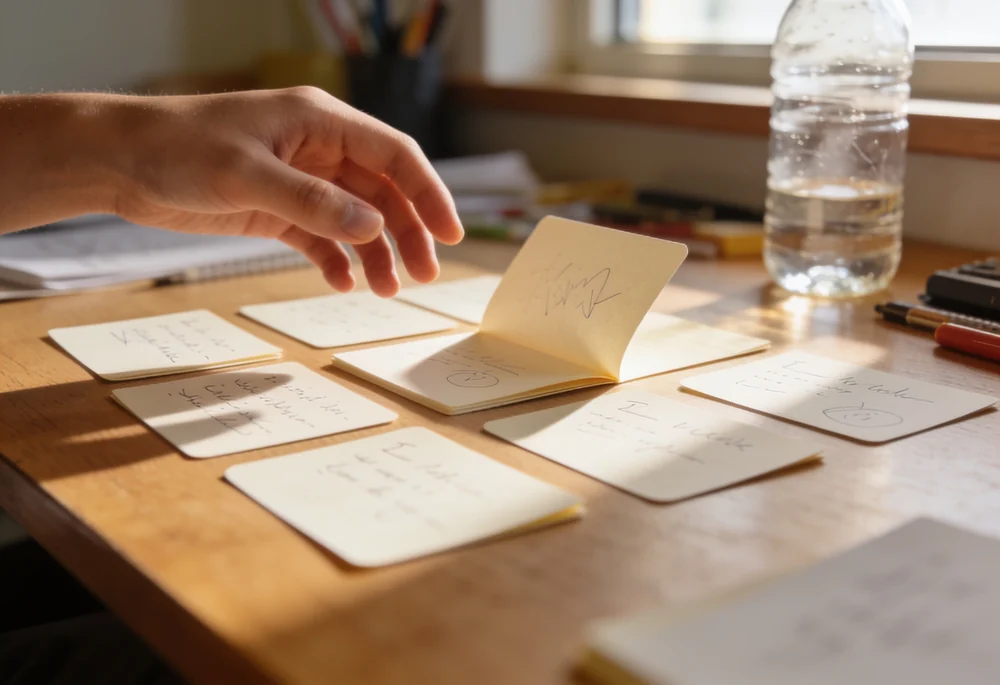
Active recall means retrieving information from memory instead of looking at it. Close the book, then answer the question. That single act of pulling the answer out strengthens the memory far more than another exposure to the page.
The classic demonstration comes from Roediger and Karpicke in 2006. Students who read a passage once and then repeatedly tested themselves recalled about 50 percent more a week later than students who spent the same time rereading it. Karpicke and Blunt repeated the punchline in Science in 2011: retrieval practice even beat concept mapping, the darling of study-skills workshops.
Here’s how to run it without buying anything:
- Flashcards, asked honestly. Physical or an app. Say the answer out loud before flipping, and don’t grade yourself on “I sort of knew it.”
- The blank-page dump. After a lecture, write everything you remember on a blank sheet, then check the notes and mark the gaps. The gaps are tomorrow’s list.
- Past papers and end-of-chapter questions. The closer your practice matches exam format, the better the transfer.
- Teach it. Explain the concept to a friend, or an empty chair, in plain words. Where you stall is where you’re weak. That’s the Feynman technique, and it’s retrieval wearing a different hat.
It’ll feel harder than rereading. That’s the point. The struggle to retrieve is what does the strengthening, so difficulty here is a feature, not a warning sign.
How does spaced repetition beat cramming?
Cramming works just well enough to fool you. You can pass tomorrow’s quiz on six frantic hours tonight, but a 2006 meta-analysis by Cepeda and colleagues covering more than 300 experiments found spaced practice reliably beats massed practice for remembering anything past the short term.
Same six hours, two very different outcomes:
| Plan | Layout of 6 study hours | What you keep after 2 weeks |
|---|---|---|
| Cramming | 6 hours the night before | Most of it fades within days |
| Spaced | 1 hour on 6 different days | The bulk of it, still retrievable |
The reason is forgetting itself. Each time you return to material just as it’s starting to slip, the retrieval effort rebuilds the memory stronger and slows the next round of decay. Review too soon and it’s too easy to count; too late and it’s gone.
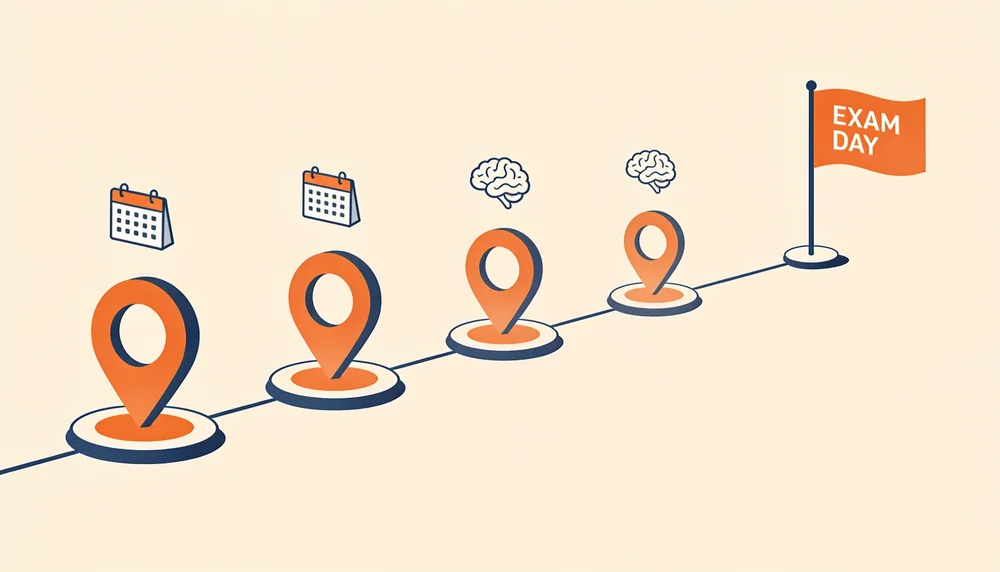
A schedule that matches the research, counted from the day you first learn the material:
| Review | When | Session length |
|---|---|---|
| 1 | Same day, before bed | 10 to 15 min |
| 2 | Day 1 | 10 to 15 min |
| 3 | Day 3 | 15 to 20 min |
| 4 | Day 7 | 15 to 20 min |
| 5 | Day 14 | 20 min |
| 6 | Day 30 or exam week | 20 to 30 min |
Working backward from a test date? Count the exact days you have left and slot the reviews in from the exam backward. Apps like Anki automate the intervals, but a paper calendar and honest flashcards get you most of the benefit.
How many hours should you study each week?
The standard planning rule in US colleges is 2 to 3 hours per credit hour per week, counting time outside class. It’s the number academic advising offices publish, and almost no study-tips article does the arithmetic for you.
| Course load | Weekly study hours | Per day (6-day week) |
|---|---|---|
| 12 credits | 24 to 36 | 4 to 6 |
| 15 credits | 30 to 45 | 5 to 7.5 |
| 18 credits | 36 to 54 | 6 to 9 |
| One 3-credit course | 6 to 9 | about 1 to 1.5 |
Worked example: a 15-credit semester at the lower bound means 30 hours a week. Split it as five weekday blocks of 4 hours plus 10 on the weekend, and each block becomes two or three 50-minute focused sessions. Suddenly “study more” turns into a schedule you can actually write down.
Weight the hours by stakes, too. A course where the final decides your grade deserves more of the pie, and the score you need on the final tells you exactly how much pressure that exam carries. If a course is already safe, bank those hours where they move your average. You can test how each grade shifts your standing before finals lock everything in.
Do sleep, breaks, and environment really matter?
They’re not decoration. Sleep is when the day’s learning gets consolidated into long-term memory, and sleep researchers have shown that both the night before studying and the night after shape how much sticks. Pulling an all-nighter converts your best-prepared hours into your worst recall. If racing thoughts keep you up before a big exam, these methods for falling asleep faster are worth 10 minutes of your evening.
Breaks protect focus rather than steal it. The Pomodoro pattern (25 minutes on, 5 off) and the 50/10 variant both work because attention degrades quietly over long unbroken stretches. Stand up, move, refill the water bottle, and keep the phone out of the break.
Environment is the cheapest upgrade available. Same desk, phone in another room, notifications off, one subject’s material out at a time. Studies of divided attention are unanimous: task-switching taxes memory formation, and “just checking” a message costs far more than the seconds it takes.
One myth to retire while we’re here: matching study methods to your “learning style” has no experimental support. Pashler’s 2008 review looked hard for evidence that visual learners learn more from visuals and found the studies didn’t hold up. Diagrams, timelines, and sketches help everyone (that’s dual coding), so use them freely and skip the label.
How do you build a weekly study plan that sticks?
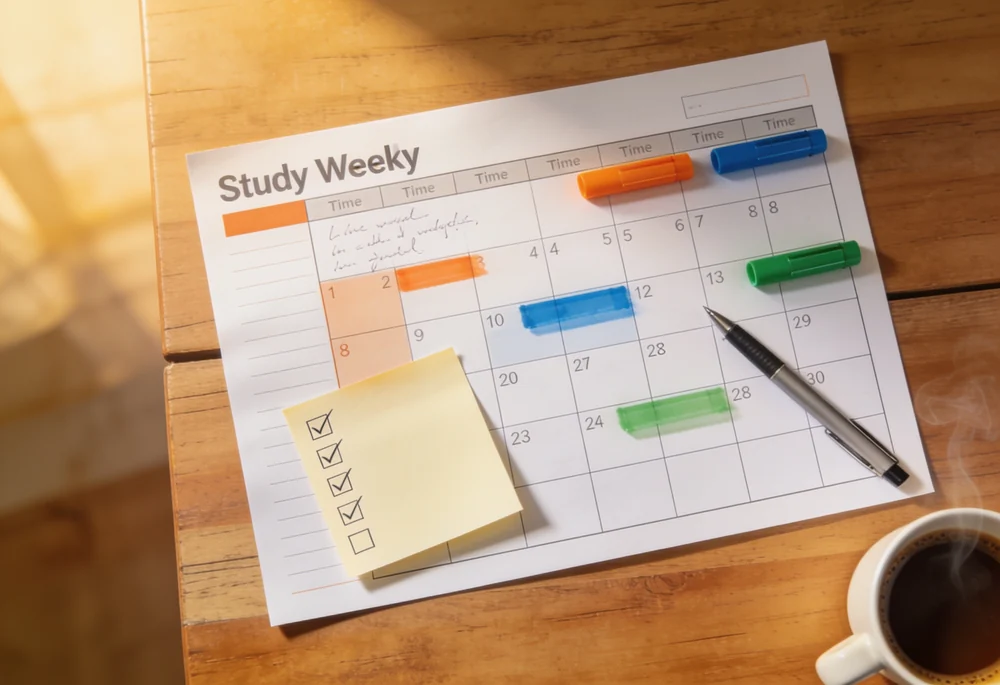
Combine everything above into a repeatable week. The plan below assumes a 15-credit load with a hard course (say, organic chemistry) and four moderate ones.
| Day | Block 1 (50 min) | Block 2 (50 min) | Block 3 (50 min) |
|---|---|---|---|
| Mon | Chem: practice problems | History: blank-page recall | Chem: flashcard review |
| Tue | Stats: past-paper questions | Chem: new material + notes | English: reading + questions |
| Wed | Chem: spaced review (day 3) | Stats: problem set | History: flashcards |
| Thu | English: essay outline recall | Chem: practice problems | Stats: spaced review |
| Fri | Chem: teach-it-aloud session | History: spaced review (day 7) | Catch-up or rest |
| Sat | Longer chem problem session | Mixed-subject interleaving | Weekly self-quiz, all courses |
| Sun | Rest | Plan next week (15 min) | Early night |
Three rules make it stick:
- Schedule retrieval, not “reading.” Every block names an output: problems solved, cards answered, pages recalled. “Review chapter 4” isn’t a task; “answer 20 questions on chapter 4 from memory” is.
- Give every course a spaced slot. Notice the day-3 and day-7 reviews built into the grid. New material always gets a same-week return visit.
- Set a goal you can miss. “Raise my stats grade to a B+ by hitting 90 percent on weekly self-quizzes” is specific enough to fail, which is exactly what makes it useful. Vague goals can’t warn you that you’re behind.
Interleaving earns its place on Saturdays: mixing problem types in one sitting feels rougher than blocking them, but it trains you to pick the right method, which is the skill exams actually test.
What should you do first, today?
Don’t overhaul everything. Pick the two changes with the highest payoff per the evidence table and run them for two weeks:
- Convert tonight’s rereading into 30 minutes of self-testing on the same material.
- Book two 15-minute reviews of this week’s hardest topic, three days apart, on your calendar right now.
That’s practice testing plus spacing, the only two techniques with a high rating in the research, installed with about zero extra study time. Once they’re habit, layer in the weekly grid, protect your sleep, and let the semester math confirm what the science already predicts: the grades follow the method.
Frequently asked questions
Practice testing, also called active recall, sits at the top of the research. In the largest review of study techniques, Dunlosky and colleagues rated it and spaced practice as the only two methods with high utility across ages and subjects. Closing the book and pulling answers from memory beats rereading in nearly every published comparison, and combining it with spacing multiplies the effect.
College planning offices use 2 to 3 hours per credit hour per week, so a 15-credit load means 30 to 45 weekly hours including class time. Spread across six days, that's roughly 3 to 5 focused hours daily. Past that point returns fall off fast, and research on spacing shows two short sessions beat one long one anyway, so protect quality before piling on quantity.
The evidence for a magic time of day is weak, but the evidence for sleep is not. Pick the window where you're consistently alert, keep it at the same time so it becomes routine, and never trade sleep for extra hours. Memory consolidation happens overnight, so an 11 pm session followed by 7 hours of sleep beats a 2 am session followed by 4 every single time.
Not the way most people think. A 2008 review by Pashler and colleagues found no solid evidence that matching teaching to a preferred style improves results. What does help everyone is dual coding, which means pairing words with diagrams, timelines, or sketches. So build visuals into your notes because they work, not because you've been labeled a visual learner.
There's no secret, and anyone selling one is skipping the research. The three moves with the strongest evidence are retrieval practice (test yourself instead of rereading), spaced practice (spread sessions out over days), and full sleep after studying (that's when memory consolidates). They're free, they're proven, and they beat every hack on this list.
Triage. Skip rereading entirely, grab past papers or end-of-chapter questions, and spend the day answering them from memory, checking, and re-testing the misses. Break every 50 minutes, space three or four passes over the day instead of one marathon, and stop in time for a full night of sleep. One day of retrieval practice beats one day of highlighting by a wide margin.
Around 5 to 10 minutes for every 25 to 50 minutes of focused work. The Pomodoro pattern uses 25 and 5, while many students settle into 50 and 10. The length matters less than what you do with it: stand up, move, get water, and stay off the feeds, because a 5-minute scroll routinely turns into 25 and drags your attention back to zero.
Calcowa's editorial team builds and checks every calculator against published formulas, then writes these guides so the numbers make sense. Each tool shows its formula and a worked example. See our methodology.
Related guides
How to Calculate GPA on a 4.0 Scale
How to calculate GPA: multiply each grade's points by its credits, add them, then divide by total credits. Full 4.0 scale chart plus cumulative GPA math.
Health & FitnessTarget Heart Rate Zones for Fat Loss
Target heart rate zone for fat loss runs about 60 to 70 percent of your max heart rate, but higher zones burn more total fat. Get the full chart and math.
Health & FitnessCalories Burned Walking: A Complete Guide
Calories burned walking depends on your weight, pace, and incline. A 155-pound person burns about 86 calories per mile at a moderate pace. See the charts.