
How to Calculate Percentage (with Examples)
How to calculate percentage: divide the part by the whole and multiply by 100. Get all 3 percent formulas, mental math shortcuts, and worked examples.
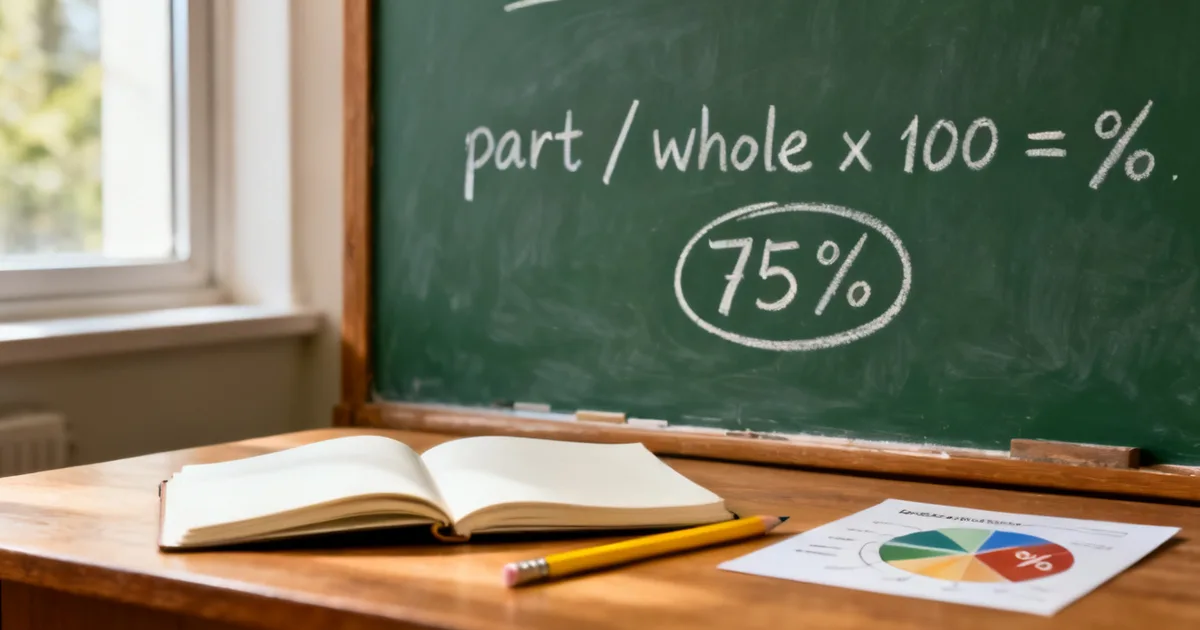
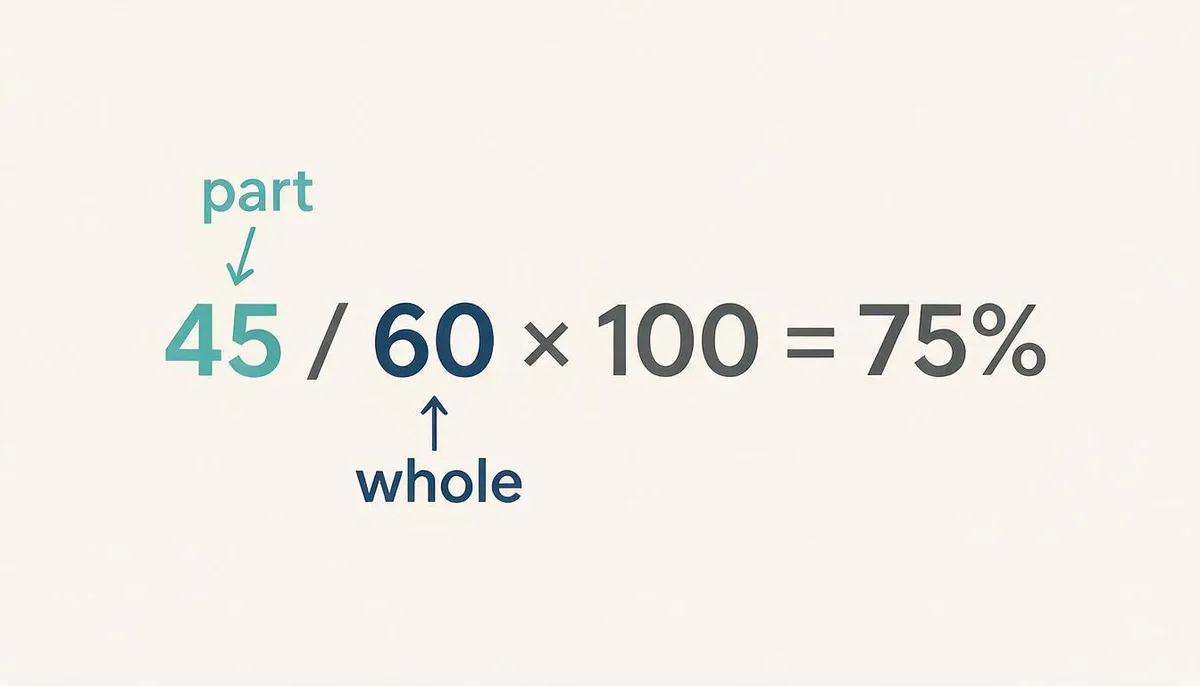
Short answer: to calculate a percentage, divide the part by the whole and multiply by 100. Score 45 out of 60 on a quiz and the math is 45 / 60 = 0.75, times 100 = 75%. That single formula settles most percent questions, but not all of them. Learning how to calculate percentage problems really means learning three setups: finding the percent, finding the part, and finding the whole. Once you can spot which one a question is asking, the arithmetic takes seconds. This guide covers all three formulas, a decoder table that matches question wording to the right one, mental math shortcuts, a fraction-to-percent chart, and the traps that catch almost everyone.
Want the answer without the setup? The percentage tool solves all three problem types and shows its work, so you can check yourself as you practice.
What Is the Percentage Formula?
Percent literally means “per hundred,” from the Latin per centum. A percentage is just a fraction whose denominator is locked at 100, which is what makes it so easy to compare things. Saying 45 out of 60 versus 38 out of 50 takes effort to rank; saying 75% versus 76% doesn’t.
The core percentage formula:
Percentage = (Part / Whole) x 100
Every other percent calculation is this formula rearranged. Solve it for the part and you get Part = Percent x Whole. Solve it for the whole and you get Whole = Part / Percent. Three versions, one relationship:
| What you’re finding | Formula | Quick example |
|---|---|---|
| The percent | (Part / Whole) x 100 | 12 / 48 x 100 = 25% |
| The part | (Percent / 100) x Whole | 25% of 48 = 0.25 x 48 = 12 |
| The whole | Part / (Percent / 100) | 12 is 25% of 12 / 0.25 = 48 |
Keep that table in your head, or bookmark it, and you’ve covered nearly every percentage question a bill, a test, or a spreadsheet will throw at you. The rest of this guide is about recognizing which row you’re in and doing the arithmetic faster.
How to Calculate Percentage of a Number?
To find a percent of a number, convert the percent to a decimal and multiply. Move the decimal point two places to the left: 30% becomes 0.30, 8% becomes 0.08, 150% becomes 1.5. Then multiply by the number.
Here’s the method on a real question, 30% of 240:
Step 1: convert the percent to a decimal. 30% = 30 / 100 = 0.30.
Step 2: multiply by the whole. 0.30 x 240 = 72.
That’s it. A few more, done the same way:
- 8% of 60: 0.08 x 60 = 4.8
- 65% of 200: 0.65 x 200 = 130
- 120% of 45: 1.2 x 45 = 54
The decimal conversion is the step people skip, and it’s the step that matters. Multiplying 30 x 240 without converting gives 7,200, which is off by a factor of 100. If an answer looks absurdly large, you almost certainly multiplied by the raw percent instead of the decimal.
There’s also a fraction path that’s sometimes faster: 25% of 48 is just a quarter of 48, so 12. No decimals needed. The conversion chart later in this guide lists the percents that collapse into clean fractions like that.
What Percent Is One Number of Another?
This is the reverse question: you have both numbers and want the rate. Divide the part by the whole, then multiply by 100. Say 18 of the 40 apartments in a building are rented. 18 / 40 = 0.45, and 0.45 x 100 = 45% occupied.
The only real trap is deciding which number is the whole. The whole is the reference amount, the thing you’re measuring against, and in word problems it usually follows the word “of.” What percent of 40 is 18? The 40 is your whole. Get them backwards and you’ll compute 40 / 18 = 222%, which should immediately feel wrong for an occupancy question.
Grades work the same way. A score of 52 out of 65 is 52 / 65 = 0.8, so 80%. So do sales figures, poll results, and attendance counts. Any “X out of Y” sentence converts with one division and one multiplication.
How Do You Reverse a Percentage to Find the Whole?
Sometimes you know the part and the percent, and the missing piece is the whole. The formula flips to division: Whole = Part / (Percent as a decimal).
Say a store tells you the $36 you paid was 60% of the regular price. The regular price is 36 / 0.60 = $60. Or a charity says the $4,500 raised so far is 30% of its goal: 4,500 / 0.30 = $15,000 total goal.
A worked check never hurts with reverse problems, because dividing when you should multiply is easy to do. Take the whole you found and run it forward: 60% of $60 is 0.6 x 60 = $36. It matches the part you started with, so the answer holds. Reverse percentages show up constantly in real life, from “20% deposit = $8,000, what’s the house price?” (8,000 / 0.2 = $40,000) to working out a full salary from a partial payment.
Which Percentage Formula Should You Use?
The formulas are easy; the reading is where people stumble. This decoder maps the wording you’ll actually see to the setup you need, something none of the textbook explanations lay out in one place:
| The wording you see | What’s missing | Setup | Worked example |
|---|---|---|---|
| ”What is 15% of 80?” | The part | 0.15 x 80 | = 12 |
| ”12 is what percent of 80?” | The percent | 12 / 80 x 100 | = 15% |
| “12 is 15% of what number?” | The whole | 12 / 0.15 | = 80 |
| ”What percent of 80 is 12?” | The percent | 12 / 80 x 100 | = 15% |
| “15% of what number is 12?” | The whole | 12 / 0.15 | = 80 |
Notice the middle column: identify which of the three quantities the question leaves blank, and the setup picks itself. Two phrasings can ask the identical thing (“12 is what percent of 80” and “what percent of 80 is 12”), so don’t let word order rattle you. Find the “of” for your whole, find the question word for your unknown, and plug in. When a problem still reads ambiguously, run it through the percent solver and compare its interpretation against yours.
How Do You Calculate Percentages in Your Head?
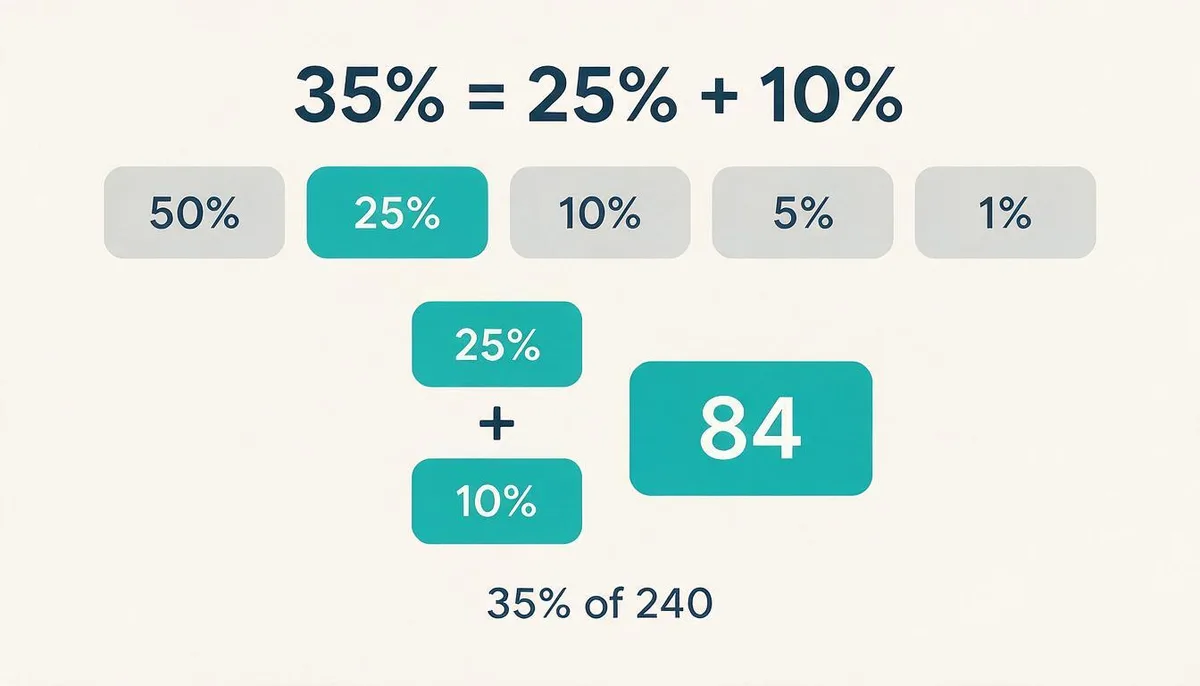
Mental percentage math runs on five building blocks, each one a single easy move:
| Block | How to get it | 240 example |
|---|---|---|
| 50% | Halve the number | 120 |
| 25% | Halve it twice | 60 |
| 10% | Move the decimal 1 place left | 24 |
| 5% | Half of 10% | 12 |
| 1% | Move the decimal 2 places left | 2.4 |
Then you stack blocks to build any percent you need. 35% of 240? That’s 25% + 10%, so 60 + 24 = 84. An 18% tip? 10% + 5% + 1% + 1% + 1%. 13% of 400: 10% gives 40, three 1% blocks add 12, total 52. With a week of casual practice, restaurant bills and sale racks stop requiring a phone. This is exactly the skill behind fast tipping, and the worked bill examples in our guide to calculating a tip lean on the same 10%-and-half trick.
The second head-math weapon is the switch trick: x% of y always equals y% of x. Both equal xy / 100, so you can flip any problem into its easier twin:
| Hard-looking problem | Flip it | Answer |
|---|---|---|
| 4% of 75 | 75% of 4 | 3 |
| 16% of 25 | 25% of 16 | 4 |
| 8% of 50 | 50% of 8 | 4 |
| 36% of 25 | 25% of 36 | 9 |
| 2% of 350 | 350% of 2 | 7 |
Whenever one side of a percent problem is 25, 50, or another friendly number, flip it and the answer often falls out instantly. It feels like a magic trick the first time, but it’s just multiplication being commutative.
Fraction, Decimal, and Percent Conversions
Percents, decimals, and fractions are three costumes on the same number, and fluent converters move between them without thinking. Decimal to percent: multiply by 100 (0.375 becomes 37.5%). Percent to decimal: divide by 100 (62% becomes 0.62). Fraction to percent: divide top by bottom, then multiply by 100 (3/8 = 0.375 = 37.5%).
These are the equivalents worth memorizing:
| Fraction | Decimal | Percent |
|---|---|---|
| 1/100 | 0.01 | 1% |
| 1/20 | 0.05 | 5% |
| 1/10 | 0.1 | 10% |
| 1/8 | 0.125 | 12.5% |
| 1/5 | 0.2 | 20% |
| 1/4 | 0.25 | 25% |
| 1/3 | 0.333… | 33.3% |
| 3/8 | 0.375 | 37.5% |
| 1/2 | 0.5 | 50% |
| 5/8 | 0.625 | 62.5% |
| 2/3 | 0.666… | 66.7% |
| 3/4 | 0.75 | 75% |
| 7/8 | 0.875 | 87.5% |
| 1 | 1.0 | 100% |
The fraction column is the secret to speed. Spot that 75% is three quarters and “75% of 32” becomes “three quarters of 32,” which is 24 with no long multiplication. Teachers drill these because they compound: every clean fraction you recognize converts a percent problem into simple division.
How Do Percentages Work with Money?
Money is where percentage skill pays rent, literally. Tips, sales tax, and discounts are the three calculations most adults run weekly, and they’re all “find the part” problems. Here’s each one worked on real numbers:
| Situation | Setup | Math | Result |
|---|---|---|---|
| 15% tip on a $62 bill | 0.15 x 62 | 6.20 + 3.10 | $9.30 |
| 20% tip on a $62 bill | 0.20 x 62 | 6.20 x 2 | $12.40 |
| 7% sales tax on $89 | 0.07 x 89 | 89 x 7 / 100 | $6.23 |
| 30% off a $150 jacket | 150 x 0.70 | pay 70% | $105 |
| 25% off $80, then 8% tax | 80 x 0.75 x 1.08 | 60 x 1.08 | $64.80 |
Two moves in that table deserve a highlight. For discounts, skip the subtraction: 30% off means you pay 70%, so multiply by 0.7 once instead of finding the discount and subtracting it. And when a discount and tax combine, multiply the factors in sequence (0.75, then 1.08); the order doesn’t change the total.
Restaurant math has its own shortcuts and etiquette questions, from pre-tax versus post-tax tipping to service charges, and our tipping guide covers those situations one by one.
What About Percentage Increase and Decrease?
Change over time is its own percentage species. The formula compares the change to the original value: Percent change = (New - Old) / Old x 100. A stock that moves from $40 to $50 gained (50 - 40) / 40 x 100 = 25%. Fall from $50 back to $40 and the drop is 10 / 50 = 20%, not 25%, because the starting base changed. That asymmetry surprises nearly everyone the first time.
That base-shift wrinkle, along with reverse changes and repeated changes, deserves its own full walkthrough, and the percent change tool handles the increase and decrease cases with the steps shown. For this guide, the one thing to remember is that percent change always divides by where you started.
Common Percentage Mistakes (and How to Avoid Them)
Most percentage errors come from four repeat offenders. Each has a one-line fix:
| Mistake | Why it’s wrong | The fix |
|---|---|---|
| Multiplying by the raw percent (30 x 240 for 30% of 240) | Off by a factor of 100 | Convert to a decimal first: 0.30 x 240 |
| Adding stacked discounts (20% off + 10% off = 30% off) | Second discount hits a smaller base | Multiply factors: 0.8 x 0.9 = 0.72, so 28% off |
| Undoing a 20% increase by subtracting 20% | The base changed after the increase | Divide by 1.20 instead of multiplying by 0.80 |
| Mixing percent with percentage points | 4% to 5% is 1 point but a 25% rise | Points = subtraction; percent = relative change |
The stacked-discount one costs real money in reverse, too: stores advertise “extra 10% off clearance” precisely because 20% then 10% sounds like 30% but delivers 28%. And the increase-then-decrease trap is why a portfolio that drops 50% needs a 100% gain just to break even.
None of these mistakes survive a five-second sanity check. Percentages map to intuition better than almost any other math: 50% is half, 10% is a dime on the dollar, 100% is the whole thing. If a result violates that gut sense, rerun the setup. And when the numbers are ugly or the stakes are real, let the percentage tool do the arithmetic while you focus on choosing the right setup.
Percentages aren’t a topic you study once; they’re a reflex you build. Start noticing them on receipts, score reports, and headlines, run the quick version in your head, and within a month the three formulas in this guide will feel less like math and more like reading.
Frequently asked questions
Divide the marks you earned by the total marks available, then multiply by 100. Score 438 out of 500 and the math is 438 / 500 = 0.876, times 100 = 87.6%. The same formula works for a single exam or a whole year: add up everything you earned, divide by everything possible, multiply by 100.
Yes, whenever the part is bigger than the reference whole. If your rent went from $1,000 to $2,500, the new rent is 250% of the old one. Growth, returns, and comparisons pass 100% all the time. The only places a percentage can't top 100 are shares of a fixed whole, like test scores or survey splits.
Convert the percent to a decimal and multiply. For 24% of 320, type 0.24 x 320 and you get 76.8. If your calculator has a % key, type 320 x 24 % instead. To find what percent one number is of another, divide the part by the whole and multiply by 100: 76.8 / 320 x 100 returns 24.
Decide which number is the whole, divide the other one by it, and multiply by 100. If 34 of 85 students walk to school, 34 / 85 = 0.4, so 40%. The order matters: 34 out of 85 is 40%, but 85 out of 34 is 250%. The number after the word 'of' is almost always your whole.
Percent measures relative change; points measure the raw gap between two percentages. If a savings rate moves from 4% to 5%, it rose 1 percentage point but 25 percent, since 1 is a quarter of 4. News about interest rates and polls usually means points, which is why the two get confused so often.
Find 10% by moving the decimal one place left, then double it. For 20% of $85, take 10% ($8.50) and double it to get $17. The same base move handles most tips: 15% is 10% plus half of that again, and 5% is half of 10%. One decimal shift powers nearly every head calculation.
Build it from easy pieces. Start with 10% (move the decimal left one place) and 1% (move it two places), then stack them. For 13% of 400: 10% is 40, 1% is 4, so 13% is 40 + 4 + 4 + 4 = 52. Halving gets you 5% and 2.5%, and 25% is just a quarter. Most everyday percentages fall to these blocks.
Calcowa's editorial team builds and checks every calculator against published formulas, then writes these guides so the numbers make sense. Each tool shows its formula and a worked example. See our methodology.
Related guides
How to Calculate Standard Deviation Step by Step
How to calculate standard deviation: find the mean, square each value's distance from it, average the squares, then take the square root. Worked examples.
Health & FitnessTarget Heart Rate Zones for Fat Loss
Target heart rate zone for fat loss runs about 60 to 70 percent of your max heart rate, but higher zones burn more total fat. Get the full chart and math.
Health & FitnessCalories Burned Walking: A Complete Guide
Calories burned walking depends on your weight, pace, and incline. A 155-pound person burns about 86 calories per mile at a moderate pace. See the charts.