
How Much Water Should You Drink a Day? A Complete Guide
How much water should you drink a day? Most adults need about 8 to 13 cups, but your weight, activity, and climate shift the number. Here's how to find yours.
Short answer: most adults need about 8 to 13 cups of water a day. The U.S. National Academies put total daily water near 91 ounces (2.7 liters) for women and 125 ounces (3.7 liters) for men, but that total counts the water in your food too. Your weight, how much you sweat, and where you live all move the number. Here’s how to land on yours.
Want your exact number in a few seconds? The water intake calculator factors in your weight, activity, and climate so you don’t have to do the math by hand.
How much water should you drink a day?
There are two common ways to answer this, and they don’t quite agree, so it’s worth knowing both.
The first is the famous “8x8” rule: eight 8-ounce glasses, which comes to 64 ounces (about 1.9 liters) a day. It’s easy to remember, and that’s really its only strength. There’s no hard science behind the exact figure, so treat 64 ounces as a sensible floor rather than a proven target.
The second comes from the U.S. National Academies of Sciences (formerly the Institute of Medicine). They set an “adequate intake” for total water at about 2.7 liters (91 ounces) a day for women and 3.7 liters (125 ounces) a day for men. The key word is total. Roughly 20 percent of your water comes from food, especially fruit, vegetables, soup, and yogurt, so the amount you actually need to drink is lower than those headline numbers.
Put simply, if you’re a woman aiming for 91 ounces of total water, you’d drink around 78 ounces (about 9 to 10 cups) and eat the rest. Neither method knows anything about you, though, which is why the next section matters more.
The body-weight method (a formula that fits you)
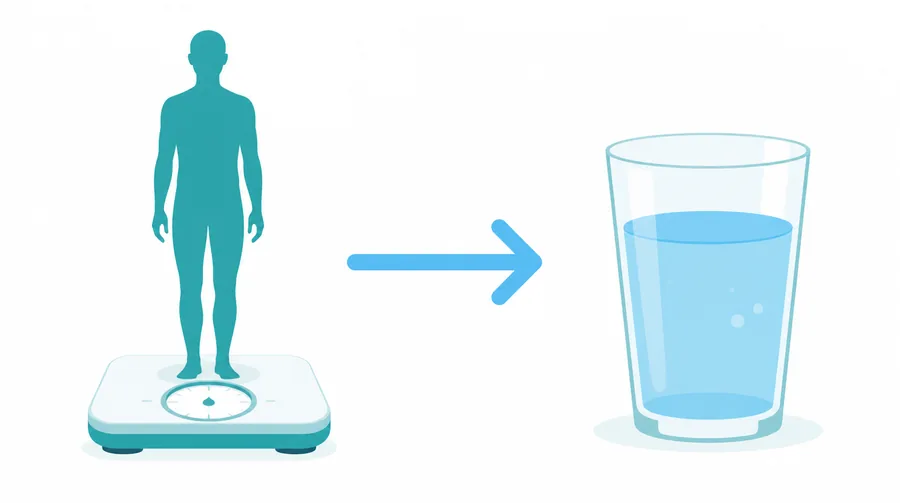
A more personal starting point is to base your water on your body weight. A widely used rule of thumb is to drink about half your body weight in pounds, as ounces of water. So if you weigh 160 pounds, you’d aim for about 80 ounces a day. It isn’t a medical prescription, but it scales with your size in a way the flat numbers don’t.
Here’s how that plays out across common weights, before any activity adjustment.
| Body weight | Baseline water (oz) | In cups | In liters |
|---|---|---|---|
| 120 lb | 60 oz | 7.5 cups | 1.8 L |
| 140 lb | 70 oz | 8.75 cups | 2.1 L |
| 160 lb | 80 oz | 10 cups | 2.4 L |
| 180 lb | 90 oz | 11.25 cups | 2.7 L |
| 200 lb | 100 oz | 12.5 cups | 3.0 L |
| 220 lb | 110 oz | 13.75 cups | 3.3 L |
Notice how a 200-pound person lands near 100 ounces, well above the 64-ounce rule. That gap is exactly why one-size targets miss. If you’d rather not memorize a formula, the water intake calculator applies this method and then adjusts it for your day.
How many ounces of water a day, in every unit
People search for their target in ounces, cups, liters, and bottles, so here’s the same amounts side by side. It helps to pick one unit and stick with it.
| Total water goal | Ounces | Cups | Liters | 16.9 oz bottles |
|---|---|---|---|---|
| Light / smaller adult | 64 oz | 8 cups | 1.9 L | ~4 |
| Women (adequate intake) | 91 oz | 11.4 cups | 2.7 L | ~5.5 |
| Men (adequate intake) | 125 oz | 15.6 cups | 3.7 L | ~7 |
| Active or hot climate | 128+ oz | 16+ cups | 3.8+ L | ~7.5 |
A quick note on the units people trip over: a half gallon is 64 ounces, a US cup is 8 ounces, and a liter is about 34 ounces. So “2 liters a day,” another common target, is roughly 68 ounces, or about four standard bottles.
How much water should a woman drink a day?
Women need a bit less total water than men on average, mostly because of body size. The adequate intake is about 2.7 liters (91 ounces) of total water, which works out to roughly 78 ounces from drinks once you count food.
Pregnancy and breastfeeding change things, and it’s worth being specific.
| Group | Total water / day | From drinks (approx.) |
|---|---|---|
| Adult woman | 91 oz (2.7 L) | ~78 oz |
| Pregnant | 101 oz (3.0 L) | ~88 oz |
| Breastfeeding | 128 oz (3.8 L) | ~104 oz |
| Adult man | 125 oz (3.7 L) | ~101 oz |
If you’re pregnant or nursing and you’re not sure, your doctor or midwife can give you a target for your situation. These are population averages, not personal medical advice.
Does exercise, heat, or altitude change how much you need?
Yes, and often by a lot. Your baseline is for a normal day. Add water on top when your body loses more of it.
| Situation | Add roughly |
|---|---|
| 30 minutes of exercise | +12 oz (350 ml) |
| Hot or humid weather | +16 to 32 oz |
| High altitude (above ~8,000 ft) | +16 oz |
| Fever, vomiting, or diarrhea | +extra, sip steadily |
| Drinking alcohol or lots of coffee | +8 to 16 oz to offset |
A hard hour at the gym in summer can easily add 30 to 40 ounces to your day. You don’t need to be precise about it. Drink before you’re thirsty, keep water nearby during exercise, and top up afterward.
How many bottles of water is that?
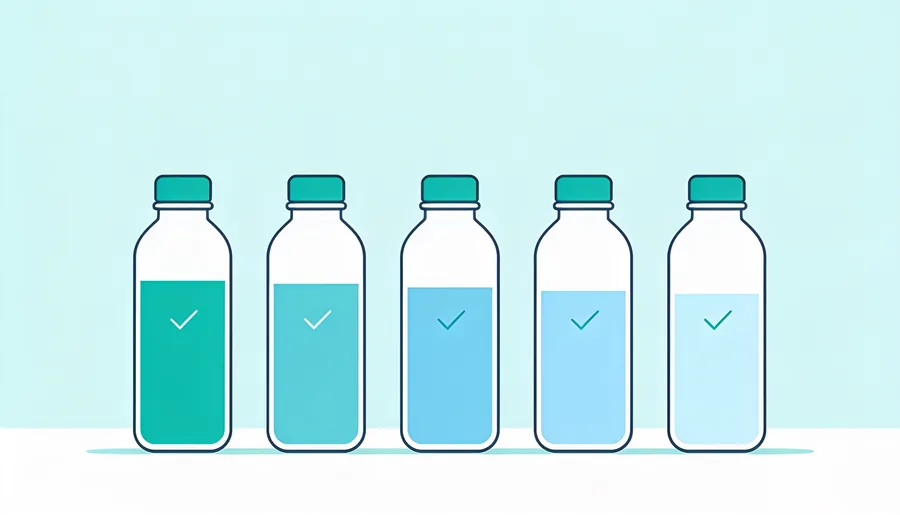
Counting bottles is easier than counting ounces for most people, so here’s the translation. The size of your bottle changes everything, which is why “how many bottles” has no single answer.
| Your bottle | Ounces each | For 91 oz (women) | For 125 oz (men) |
|---|---|---|---|
| Small disposable | 16.9 oz | ~5 to 6 | ~7 |
| Standard reusable | 24 oz | ~4 | ~5 |
| Large reusable | 32 oz | ~3 | ~4 |
| 1-liter bottle | 34 oz | ~3 | ~4 |
By the way, disposable bottles are 16.9 ounces because that’s exactly half a liter (500 ml), a metric size that got kept when the bottles came to the US. Now you know why the number’s so odd.
How much water should you drink to lose weight?
Water won’t melt fat, and any site that says otherwise is overselling it. What water does do is support a calorie deficit in a few honest ways.
Drinking a glass 20 to 30 minutes before a meal tends to make you eat a little less, because part of what feels like hunger is mild thirst. Swapping a sugary soda or juice for water removes those calories outright, which adds up fast over a week. And staying hydrated keeps your energy up so you’re more likely to move and train.
If weight loss is the goal, the real lever is calories in versus calories out, and water is a helper, not the engine. Pair your hydration with the calorie calculator to set a target you can actually hit.
What are the benefits of drinking enough water?
Staying hydrated isn’t just about avoiding thirst. Water does steady, unglamorous work all day.
- It regulates temperature. Sweat is your cooling system, and it runs on water.
- It cushions joints and organs and keeps tissues moist.
- It moves nutrients and oxygen through your blood and helps flush waste through your kidneys.
- It supports focus and mood. Even mild dehydration can leave you foggy, tired, or headachy.
- It aids digestion and helps prevent constipation.
None of this requires drinking gallons. It requires drinking enough, consistently.
Signs you’re drinking enough, and signs you aren’t
Your body tells you more than a number can. The easiest daily check is the color of your urine: pale yellow like lemonade usually means you’re well hydrated, while dark amber means drink more. Here’s the fuller picture.
| Drinking enough | Signs of dehydration | Signs of too much water |
|---|---|---|
| Pale yellow urine | Dark yellow or amber urine | Very frequent, fully clear urine |
| Rarely feel thirsty | Thirst, dry mouth | Nausea or headache |
| Steady energy | Fatigue, dizziness | Confusion, in severe cases |
| Regular bathroom trips | Infrequent urination | Swelling in hands or feet |
| Moist skin and lips | Dry skin, headache | Muscle weakness or cramps |
If you notice the middle column often, nudge your intake up. If you’re forcing so much water that you feel sick, that’s your cue to ease off, which brings us to the real limit.
Can you drink too much water?
You can, and it’s worth understanding even though it’s rare. When you drink far more water than your kidneys can clear, the extra water dilutes the sodium in your blood. That condition is called hyponatremia, sometimes described as water intoxication, and in serious cases it’s a medical emergency.
It usually takes a lot to get there, very roughly more than a liter an hour for several hours, which is why it shows up in endurance athletes and hazing incidents rather than normal life. The practical takeaway is simple: spread your water across the day, and don’t chug enormous volumes in a short window. Your body handles a steady stream far better than a flood.
How to actually hit your target
Knowing the number is the easy part. Building the habit is where most people slip. A few things that work:
- Start with a glass when you wake up. You’ve gone all night without water.
- Keep a bottle you like within reach. Sight is a surprisingly strong cue.
- Anchor drinks to routines, like a glass with every meal and every coffee.
- Flavor it with lemon, cucumber, or mint if plain water bores you.
- Eat your water too. Watermelon, cucumber, oranges, and soup all count toward the total.
Set a realistic goal from the water intake calculator, pick the unit you’ll actually track (bottles are easiest for most people), and let the habit do the rest. You don’t need to be perfect. You just need to be close, most days.
Frequently asked questions
Most healthy adults need roughly 8 to 13 cups of plain water a day. The U.S. National Academies put total daily water at about 91 ounces (2.7 liters) for women and 125 ounces (3.7 liters) for men, but that figure includes water from food, which supplies about 20 percent. Your body weight, activity level, and climate move the number up or down.
For many small or lightly active adults, 64 ounces (the old eight 8-ounce glasses rule) is close to enough. Larger, more active people, or anyone in a hot climate, usually need more. Sixty-four ounces is a floor to build on, not a universal target.
Women need about 91 ounces (2.7 liters) of total water a day, or roughly 78 ounces (about 9 cups) from drinks alone. Pregnancy adds about 10 ounces and breastfeeding adds about 25 ounces per day.
Yes, though it's rare. Drinking far more than your kidneys can clear (very roughly a liter an hour for hours) can dilute blood sodium and cause hyponatremia, which is dangerous. Spreading water through the day and not forcing huge amounts at once keeps you safe.
Water itself has no calories and can help in small ways. A glass before meals can reduce how much you eat, and replacing sugary drinks with water cuts calories directly. Water won't burn fat on its own, but it supports a calorie deficit.
It depends on bottle size. A common disposable bottle holds 16.9 ounces, so a 91-ounce target is about 5 to 6 bottles for women and a 125-ounce target is about 7 bottles for men. A 1-liter bottle (about 34 ounces) means roughly 3 to 4 bottles a day.
Calcowa's editorial team builds and checks every calculator against published formulas, then writes these guides so the numbers make sense. Each tool shows its formula and a worked example. See our methodology.
Related guides
Target Heart Rate Zones for Fat Loss
Target heart rate zone for fat loss runs about 60 to 70 percent of your max heart rate, but higher zones burn more total fat. Get the full chart and math.
Health & FitnessCalories Burned Walking: A Complete Guide
Calories burned walking depends on your weight, pace, and incline. A 155-pound person burns about 86 calories per mile at a moderate pace. See the charts.
Health & FitnessWhat Is a Healthy Body Fat Percentage?
A healthy body fat percentage depends on your sex and age. See the full range charts, how to measure yours accurately, and why it beats BMI as a marker.